Bright and early Monday morning of this week I giddily awoke, made a cup of coffee, put on a dark black t-shirt (the one with NY's jazz club the Village Vanguard on the front), jumped in my car and drove toward the glowing orange sun. I also had on pants!
It was about 6:45 in the A.M. and today was chicken slaughtering day. I feel fairly confident that I was one of only 4 other people in the Greater Athens area that were going to be slaughtering, scalding, plucking, eviscerating, chilling and then packing 100 chickens under God's blue sky.
For the last 8 weeks two small square pens, approximately 10x10 constructed of wood, chicken wire and a tarp had been holding 50 chickens each as they were moved once per day across a pasture beneath a palonia orchard. These chickens and these pens, undneath these trees, on this grass, on this farm, in this day in age offers more hope, knowledge, and wisdom than may be evident upon first glance.
Chickens haven't been treated very well by humans over the last 30-40 years or so. What I mean by that is imagine spending your entire life at a Rolling Stones concert, standing room only, shoulder to shoulder, in a windowless stadium, all the bathrooms are closed, and the band never shows up. That's kind of what life is like for a factory chicken.
Having spent some time in these chicken factories, I've never met a farmer who loves what they are doing. As many people have pointed out, it doesn't really resemble farming. When you walk in, you are smacked in the face by the heavy smell of ammonia. There are no windows so the 50x500 foot house is dimly lit (just about all day to keep the chickens eating 24x7). There are 30,000 chickens, and your job is to pick up the ones that have died, and make sure the automatic waterers, feeders, and temperature monitors are working. Getting a kid to go into one of those things day after day can't be easy.
With pastured poultry, a farmer is outside. The chickens have all the fresh air and sunlight they could want. They are moved each day onto fresh grass which they happily munch on, and pick through the soil looking for bugs. Each day they lay down a fresh layer of manure to help fertilize the pasture, which helps the grass grow for the cattle that will be following behind. They don't have to spend a single day in yesterday's excrement. It's fresh, clean and sanitary.
Now in the end the chicken does still get killed and eaten. Such is the price paid by a domestic fowl in an omnivorous world. But the important question is, did the animal live a good, tranquil, healthy life? Was the animal under intense stress? Was it deprived of its "unalienable rights" of fresh air, grass, bugs, ability and room to move around, freedom from one's own feces, and sunshine. No. By all accounts these birds have been happy!
Our crew of 3 were excited. This was the inaugural day of chicken slaughter on this particular farm. The very first batch. There was never going to be another first time, and I wanted to be a part of the ceremonial celebration of the good lives these chickens had led, and the unique nourishment they would afford to a whole mass of people.
Set up began promptly at 7AM. There were cutting tables to wash down, kill cones to set up, a turkey fryer would serve as our scalding pot. A brand new feather master would pluck the feathers. Then there was a tray for catching the blood beneath the cones, and a garbage can for the eviscera, and another tub for offal (the feathers). We had sharp knives, and matches, and a pulley system for dipping the birds in the scalder. It was all set up in stations. After about an hour of getting things together, we were anxious to try it out.
The birds were taken from their pen out in the pasture and put into a pen on the back of a pickup. Each bird was then stuck into an upside down traffic cone which was affixed to 2x4 across two trees. The top of the cones had been cut off so that the birds head was sticking out of the bottom. In such a position the birds can't move their wings and get very still and quiet. The most difficult part of the operation is the kill itself. It's done by simple grabbing the birds head and cutting their main artery on the side of its neck. This may be the hardest part of the procedure because the bird's don't die instantly. Cutting their artery allows the heart to continue to beat removing the blood from the body which can leave a bad taste to the meat.
Once bled, each bird (now dead) is removed from the cone, and it's fit put into a pulley situated over a vat of hot water at 145 degrees. The bird is then dipped / submerged into the hot water repeatedly for 1 minute. This loosens the birds feathers for plucking. Rather than hand plucking, they are placed into an apparatus that resembles a large salad spinner with little rubber fingers with grooves in each finger that grasp and remove the feathers as the bird is spun around and around. As they spin around a mist of water continues to clean the bird.
Once the feathers have been removed, the birds now are starting to look like food. They are placed on the cutting table and the head is simply pulled off. The feet are removed at the joint, leaving the end to your drumstick handle. The oil gland above their tail is cut off, then a cut is made at the neck to seperate the esophogus and the crop. To eviscerate a small sideways cut is made above the anus (or the "vent" is a nicer way to put it). Enlarge the opening and then scoop out the organs in a scooping motion. The trick is not to break the intestines or especially the gall bladder (a bright blueish green organ that secretes bile to the liver). The lungs kind of cling to the rib cage and have to scraped out, then the anus is cut out, and a hose is used to wash to wash the body cavity clean. That's it. Throw it in a tub of ice water to cool the body down and it's time to go home and eat chicken.
I spent about 5 hours on the farm that morning with my other excited co-horts. I stopped at one point to exclaim, "This is fun!" And it was. My real job was expecting me so before we finished all 100 birds (we were over half way there) I had to head off.
It was about noon and as I drove back into Athens I felt like an adventure. There was a fresh whole chicken in a ziploc bag on the seat next to me. I went in my apartment and threw the bird in the fridge while I took a quick shower to rinse the smell of chicken fat from my skin. I put on clean clothes, grabbed my laptop, jumped on my bike and headed towards campus. As I looked around at people walking down the sidewalk I thought how lucky I'd been to have spent the morning on a farm just out of town contributing to the cycle of life. It was Monday and it had officially become the Week of Chicken.
The first day I had Thai Peanut Sauce stir fry chicken breasts and tenderloin with bok choy, brocolli, onions and garlic. The remainder of that meal I had for lunch today. Day two was baked Jamaican jerk chicken legs cut into slices and put on a sandwich of locally baked sourdough bread, and some organic lettuce from California probably, a little Grey Poupon and Mayonaisse. Third night I used what was left to make my mother's famous chicken casserole. You're going to pass out when you hear the ingredients. One can cream of chicken soup, 8 oz sour cream, 3 breasts of chicken, butter the dish, crush one whole pack of Ritz crackers on top, drizzle butter on the crackers. I can't believe I didn't die of heart disease eating that way growing up. But it's delicious and this week is the first time I've ever made it myself. The family recipe is alive and well.
The only way I can get closer to my food now is to get my own farm. The temptation is growing.
Till next time,
Justin
Thursday, June 28, 2007


Sunday, April 8, 2007
The Blessing of Food
One of my best friends made a dramatic decision a few years ago just shortly after a very brief stint working for the Howard Dean presidential campaign. For reasons unknown and mysterious to me, he decided to become a farmer.
My friend had always been a bit unconventional, which is probably apparent considering his devotion for Howard Dean, but he’d obtained a bachelor’s degree from a very respected liberal arts college and shortly thereafter landed a job as Executive Director of a small non-profit tasked to defend a very grand resource; the Coosa River Watershed. The job followed a canoe trip he had completed of the entire Coosa / Alabama River system, a voyage lasting three months beginning in the mountains of Georgia and ending in the Gulf of Mexico at Mobile Bay, Alabama. Our friendship was born of our mutual passion for rivers, and most of our get-togethers involved paddling, fishing, hiking and camping adventures all across north Georgia.
One of the great pleasures of making friends with eclectic and determined individuals is the opportunity to watch them as they travel down winding and enriching new paths in life. He called me after returning from Iowa and a thoroughly disappointing experience on the campaign trail and informed me that he was going to start farming. After one year of intense training, living and working with a farm family in the hill country north of Asheville, North Carolina, he returned to Georgia and worked out a deal to set to work on a piece of river bottom land near Ranger. What followed was nothing short of miraculous.
For the first four months he lived in a tent underneath a tarp, cluttered about with all his earthly belongings. He had a phone line, and he’d convinced the power company to install a meter so he’d have power, even though there was no house associated with it. Other than that there was nothing but bare ground, a vision, and a whole heap of work. Many hands make light work, and my friend had a knack with people. He’d maintained close ties with his college community and as a result was rarely alone on his little patch of soil. If you dropped by for a visit, he’d have a job waiting for you.
Within just one year the farm was cultivating fruits and vegetables on about three to four acres. He’d invested in a tractor and a beat up pickup, erected a 100 foot hoop house, a seedling greenhouse, and with a lot of help from friends had constructed a pole barn house roughly 30 by 40 foot and 16 feet high with a tin roof. The fact that he had built a house in a matter of a few months impressed me the most. The design was unconventional, but practical and inexpensive. He’d put in subflooring with insulation underneath, and heated the home using a wood burning stove set dead center with the pipe going straight through the tin roof.
His most ingenious idea was constructing the walls of the barn out of inexpensive vinyl billboard sheets. Billboard advertisements are printed on heavyweight, weatherproof, vinyl sheets. He was able to purchase two of these for a couple hundred dollars and fasten them as his walls. When sitting inside the house one of the walls featured a floor to ceiling picture of a Shoney’s Big Boy hamburger and another wall featured a Chrysler 300 sedan. There was no indoor plumbing but there was a wash basin with a bucket underneath. Hot water had to be heated atop the wood burning stove. There were two bedrooms which were actually 8x10 foot lofts sitting above my friend’s library/office on one side and living room on the other. He had an internet connection, and a television, VCR, and stereo. It was one of the coziest, cutest little homes I’ve ever been in, and it was a happy place.
My visits to the farm had a deeper impact on me than I realized at the time. One of the first things I noticed was that the foods my friend was eating were a lot different from the foods I typically ate. The breads and cereals were always whole grain, and often fresh. I remember thinking that the flavors were a lot more complex, I wasn’t sure that I liked them at first, but I could certainly tell that there was a density to these foods that I didn’t feel when eating white bread. Most of the folks on the farm were crazy about salads, and I was exposed to a world of greens I never knew existed. A lot of thought went into the food eaten on the farm. One of my more exciting visits occurred a few weeks after I had hit a small deer on the highway, taken it home and cleaned and dressed it, then carried some of the hams to the farm to be ground up into hamburger meat. It was fun to swap food and swap stories. A woman who lived nearby would bring her farm fresh eggs and trade for fresh strawberries out of the field and other produce of the week.
One of my first visits after the pole barn had been completed, there were about four of us there including my friend’s girlfriend, and we had all pitched in to prepare this great meal of fresh foods now spread out on the table. We were about to sit down and eat when my friend paused and said, “Let’s bless this food.” It was the first time I’d ever heard him suggest such a thing. The brief prayer that followed will always be a moment that I will remember. In a short period of time farming had affected a deep change in my friend’s life. His generous spirit, his strength, his humility, his calm all came into focus in his life as a farmer. I felt so happy for him, so proud of him, and so inspired by his example. Little did I know that moments like this would ultimately penetrate and influence the course of my own life just as deeply.
As his words of thanks put a blessing on the meal, the moment allowed each of us to reflect on the importance of our simply being together and sharing in good work and good food and good company. I’ve thought a lot about why that blessing, that meal, in that house, with those friends was so poignant to me. Since then I’ve sought the occasion to bless a meal. It’s a practice I fail to do everyday, but in the seeking I’ve opened a whole new world of meaning and relationship with the people who daily cooperate with the earth so that the rest of us can have something to eat.
My friend had always been a bit unconventional, which is probably apparent considering his devotion for Howard Dean, but he’d obtained a bachelor’s degree from a very respected liberal arts college and shortly thereafter landed a job as Executive Director of a small non-profit tasked to defend a very grand resource; the Coosa River Watershed. The job followed a canoe trip he had completed of the entire Coosa / Alabama River system, a voyage lasting three months beginning in the mountains of Georgia and ending in the Gulf of Mexico at Mobile Bay, Alabama. Our friendship was born of our mutual passion for rivers, and most of our get-togethers involved paddling, fishing, hiking and camping adventures all across north Georgia.
One of the great pleasures of making friends with eclectic and determined individuals is the opportunity to watch them as they travel down winding and enriching new paths in life. He called me after returning from Iowa and a thoroughly disappointing experience on the campaign trail and informed me that he was going to start farming. After one year of intense training, living and working with a farm family in the hill country north of Asheville, North Carolina, he returned to Georgia and worked out a deal to set to work on a piece of river bottom land near Ranger. What followed was nothing short of miraculous.
For the first four months he lived in a tent underneath a tarp, cluttered about with all his earthly belongings. He had a phone line, and he’d convinced the power company to install a meter so he’d have power, even though there was no house associated with it. Other than that there was nothing but bare ground, a vision, and a whole heap of work. Many hands make light work, and my friend had a knack with people. He’d maintained close ties with his college community and as a result was rarely alone on his little patch of soil. If you dropped by for a visit, he’d have a job waiting for you.
Within just one year the farm was cultivating fruits and vegetables on about three to four acres. He’d invested in a tractor and a beat up pickup, erected a 100 foot hoop house, a seedling greenhouse, and with a lot of help from friends had constructed a pole barn house roughly 30 by 40 foot and 16 feet high with a tin roof. The fact that he had built a house in a matter of a few months impressed me the most. The design was unconventional, but practical and inexpensive. He’d put in subflooring with insulation underneath, and heated the home using a wood burning stove set dead center with the pipe going straight through the tin roof.
His most ingenious idea was constructing the walls of the barn out of inexpensive vinyl billboard sheets. Billboard advertisements are printed on heavyweight, weatherproof, vinyl sheets. He was able to purchase two of these for a couple hundred dollars and fasten them as his walls. When sitting inside the house one of the walls featured a floor to ceiling picture of a Shoney’s Big Boy hamburger and another wall featured a Chrysler 300 sedan. There was no indoor plumbing but there was a wash basin with a bucket underneath. Hot water had to be heated atop the wood burning stove. There were two bedrooms which were actually 8x10 foot lofts sitting above my friend’s library/office on one side and living room on the other. He had an internet connection, and a television, VCR, and stereo. It was one of the coziest, cutest little homes I’ve ever been in, and it was a happy place.
My visits to the farm had a deeper impact on me than I realized at the time. One of the first things I noticed was that the foods my friend was eating were a lot different from the foods I typically ate. The breads and cereals were always whole grain, and often fresh. I remember thinking that the flavors were a lot more complex, I wasn’t sure that I liked them at first, but I could certainly tell that there was a density to these foods that I didn’t feel when eating white bread. Most of the folks on the farm were crazy about salads, and I was exposed to a world of greens I never knew existed. A lot of thought went into the food eaten on the farm. One of my more exciting visits occurred a few weeks after I had hit a small deer on the highway, taken it home and cleaned and dressed it, then carried some of the hams to the farm to be ground up into hamburger meat. It was fun to swap food and swap stories. A woman who lived nearby would bring her farm fresh eggs and trade for fresh strawberries out of the field and other produce of the week.
One of my first visits after the pole barn had been completed, there were about four of us there including my friend’s girlfriend, and we had all pitched in to prepare this great meal of fresh foods now spread out on the table. We were about to sit down and eat when my friend paused and said, “Let’s bless this food.” It was the first time I’d ever heard him suggest such a thing. The brief prayer that followed will always be a moment that I will remember. In a short period of time farming had affected a deep change in my friend’s life. His generous spirit, his strength, his humility, his calm all came into focus in his life as a farmer. I felt so happy for him, so proud of him, and so inspired by his example. Little did I know that moments like this would ultimately penetrate and influence the course of my own life just as deeply.
As his words of thanks put a blessing on the meal, the moment allowed each of us to reflect on the importance of our simply being together and sharing in good work and good food and good company. I’ve thought a lot about why that blessing, that meal, in that house, with those friends was so poignant to me. Since then I’ve sought the occasion to bless a meal. It’s a practice I fail to do everyday, but in the seeking I’ve opened a whole new world of meaning and relationship with the people who daily cooperate with the earth so that the rest of us can have something to eat.
Wednesday, March 21, 2007
Here we go Again!
Hello folks.
I'm back. So after a gentle respite from writing I have decided it is time once again to force the issue by committing to a blog format. I have learned that you write more when people expect you to write.
Beginning in April and ending in November I wrote extensively about a cross country cycling adveneture to discover America's Farms. You can find that Blog at www.farmlandconservation.org. That experience has led me onwards to a whole new world of exciting challenges and experiences with farm policy, local Georgia farms, opportunities in sustainable agriculture.
I have learned from my prior writing experience that you simply cannot retain nor make sense of your experiences unless you are capturing them along the way, all the little quotes that people say, your impressions at the time. They make a huge impact on the value of those stories. Well I don't won't to allow any more of them to be lost than already have so I'm going to begin sharing them again here.
This is just the warm-up. I'm a little out of practice already but I'll be back up to speed soon.
Thanks for coming back.
I'm back. So after a gentle respite from writing I have decided it is time once again to force the issue by committing to a blog format. I have learned that you write more when people expect you to write.
Beginning in April and ending in November I wrote extensively about a cross country cycling adveneture to discover America's Farms. You can find that Blog at www.farmlandconservation.org. That experience has led me onwards to a whole new world of exciting challenges and experiences with farm policy, local Georgia farms, opportunities in sustainable agriculture.
I have learned from my prior writing experience that you simply cannot retain nor make sense of your experiences unless you are capturing them along the way, all the little quotes that people say, your impressions at the time. They make a huge impact on the value of those stories. Well I don't won't to allow any more of them to be lost than already have so I'm going to begin sharing them again here.
This is just the warm-up. I'm a little out of practice already but I'll be back up to speed soon.
Thanks for coming back.
Friday, November 17, 2006
Mission Accomplished - The Big Wrap Up
The Source of Sustenance
My coast to coast bicycle journey in search of how to preserve America's family farms has successfully been completed. After having a few pictures taken of dipping my front tire in the Pacific Ocean I arrived in Astoria, OR on Friday, October 27th with a big smile on my face. Riding a bicycle from one ocean to another, across ten states, covering 5,000 miles, visiting nearly 80 farms over the course of four and a half months is not an easy experience to summarize in a few words. The first word that comes to mind is “fortunate.” I was fortunate that God put into my mind the desire and the conviction to carry out such a thing, and that I was physically and mentally capable and determined enough to complete the effort. My final day began with a walk along a secluded beach, listening to the sounds of the ocean and filled with a rising sense of thankfulness. I never went hungry, I never suffered injuries, was never harassed (save the occasional honking of a horn), and was never turned away when in need of assistance or a place to stay. Perhaps calling it “good fortune” minimizes the significance of my well being during these last months to a sort of cosmic fluke; an uncanny roll of the dice. Perhaps a more accurate description of how I'm feeling at the end is superbly blessed.
The final dipping of the tire in the Pacific Ocean at Cannon Beach. (Goonies rock in the distance)

The accomplishment itself, of overcoming all the psychological and physical obstacles and completing a hard won goal, has strengthened my faith and confidence in my own abilities. This is a new perspective for me, and one to be cherished. About two-thirds through the trip I began hesitantly mentioning to people that I wanted to write a book, but I wasn't quite sure I could do it. “If you can ride your bike across the country,” they responded, “you can do anything you set your mind to.” That statement coupled with a now tangible achievement has lifted the limits I formerly imposed on myself. When plagued with doubt I can always remind myself, “If you could ride your bike across the country, why not this?”
I have never learned more in a shorter period of time than I have these last few months. First and foremost, I will never be able to look at food the same way again. All food has an origin, and I will enjoy food best when I have an understanding and a respect for those origins. There are lots of ways to raise cattle, to grow an apple, to plant and harvest wheat, to operate a dairy. All food is not the same; there is a story behind our sustenance. A farmer's philosophy, practice, and knowledge greatly determine the nutrition of the food, the well-being of the animals, the integrity of the landscape, the character of the family, and the culture of the community. When we buy food at the grocery store we rarely know any of these things. In the midst of our so called “information age”, we have never known less about the origins and the impacts of the food we consume everyday. If my journey was in part a search for more enlightened living then my next steps are too seek out locally produced foods, indeed, even encourage them. My food dollars spent at the grocery store just don't support the things I care about anymore.
To say that I've developed my interest in agriculture the long way around would be an understatement. I grew up in a suburb of Birmingham, Alabama. I'm certainly not ashamed of my roots, but I also recognize that city life deprives the human spirit of a deep understanding of the source of all things. For the urbanite, our sustenance in the form of food, water, and even fresh air is generated in some mysterious manner on lands unknown. We take for granted the processes of nature, or the labor of our fellow man that keeps us alive, and as a result we make poor decisions. These decisions have had consequences to the health of our bodies, and to the health of rural communities.
I am grateful that after so many years, my ignorance about food and how it is produced is slightly less complete. The ground feels a little more solid beneath my feet as a result. But it has been the means by which I have acquired this knowledge that I now recognize as so unique. How fortunate I've been to study one of the most basic aspects of our daily nourishment; not in a classroom, not from a book, but directly from the farm families whose very lives provide something for the rest of us to eat. I witnessed hundreds of little snapshots of mankind's relationship to the land. As I learned about wheat, or cattle, or peaches, it was always within the human context of an individual, a family, a farmhouse located in a particular valley, situated in a particular state. As I roll over the trip in my mind, each farmer had a unique story to tell, and because I was looking, some wisdom to share. Before the printing press, before radio, before t.v., and before the Internet, our knowledge of the world was exchanged orally, directly from individual to individual. This form of communication differs from the others in that it requires no technology, it is direct, it is personal, it is interactive, and it is relational. In the process of my search for knowledge and understanding, I ended up gaining friends.
It hardly seems possible that in the course of a few hours I would make such strong connections with total strangers. I think it had something to do with the bicycle. A bicycle traveler is easier to trust. If we were up to no good, we sure hadn't devised a very good get away plan. And because of our vulnerability, the human heart is called to assist. By riding thousands of miles on a bicycle to see them, and asking them sensible, important questions, I often sensed my hosts rediscovering the significance in the way they lived their lives, and the value of their contribution.
“So what is it going to take to keep farmers farming?” This was but one of many ways I asked the question at the heart of this trip. An easy answer never materialized. What did materialize, in my heart and mind, is a deep appreciation for the land and the beautiful way in which God and nature have allowed us to provide for our own nourishment. The diverse, and often inconsistent answers to my question may come from farmers themselves, from more enlightened consumers, from farmers markets, from alternative food sources, from public policy, or from rural communities that can take charge of their identities and their future. But the starting point for such grand undertakings are simple enough. Each individual will have to pause a moment, examine their life, and make a conscious decision to rekindle a relationship with the source of their own sustenance.
Thank you to everyone who has experienced this journey along with me. I received so much support and encouragement throughout the adventure, and as a result I never felt alone. It also inspired me to push on during the rough patches. Without the prayers, the kind words, and yes, the donations and t-shirt purchases, I don't believe that this trip would have been the success that it has become. I owe an impossible debt to a great many generous souls out there. My only hope for repayment is to continue down the strange path of discovery I've now found. I promise to share some stories along the way.
I think this has to be my favorite photo from the trip. It's me and Susana Lein posing American Gothic style in celebration of our efforts to rescue her delicious Bloody Butcher cornmeal corn. Our tools were simple....stakes, twine, and a small sledge. Doesn't everyone use these tools when growing corn? One of us is taking our re-enactment a bit more serious than the other.

Friday, November 3, 2006
Final T-shirt entries
I sure enjoyed all the t-shirt entries I received. I'll try and compile them all on one page and let folks decide which is their favorite. Anyone ever come up with any bright ideas for an award? Now this was what I was hoping for. Farmer models looking sexy in their lettuce. Awesome. Big thanks to my good friend Noelia Springston for sending this photo of her husband laying in a bed.  My handsome and intelliget cousin Harris Blackstone supporting the cause. Thanks again to everyone who purchased a shirt. I wouldn't have been able to do the trip without your contribution. I'll try and compile a list of my benefactors. | |||
| |||
|
Message from a stranger
I received this e-mail message after my final day of riding....
Hello,Props to your wonderful, inspiring efforts. I admire yourdetermination and feel honored to live in the city that you celebrateyour journey's end. I was driving home and noticed how gracefully youglided up the quite steep hill outside our house on Franklin Ave.Most cyclists are huffing and laboring up it, but I sensed there musthave been some experience in your pedal strokes. Looked up the siteon the bike trailer sign and found such an inspiring endevor that gaveme a few shivers as I beheld the beautiful pictures of your journey.I am totally behind you and your mission. I often wonder what willhappen to the farms that so many people identify with as their roots.They may have some ancestor that was involved in some form of lifesustaining ariculture or might remember the neighbor's field of melonswhich has now gone to land developers. Where will we be when we areno longer identifying ourselves or at least acknowledging that withoutthis connection with the land we live on, it may give way beneath us?I had a short experience with the joys of farming in my years inhighschool at a self-supporting school. Some of the most memorableyears of my life were spent there dividing studies and work during theday. The work, the most enjoyable part of the day, was on the smallorganic farm which supplemented the schools income and also thecafeteria menu. There was also a small flock of wool sheep that Ipersonally tended to each day as a part of my duties. The wonderful feelings of scooping up freshly plowed earth in your hands, pulling upthe first tender carrots, the ache of the whole body after anafternoon of hay bucking. None of this can be adequately described inwords.
The joy all of these memories give me hope that one day my husband(whom I cultivated a friendship with while working on this same farm)and I will be able to try our hands at sharing life with the land.Thank you for reminding me of how precious our country's agricultureis and for your valiant efforts to remind the rest of the country ofthe same.Congratulations and hope your trip home is peaceful and safe.
Sincerely,
Carrie
My reply: Thanks Carrie!
Hello,Props to your wonderful, inspiring efforts. I admire yourdetermination and feel honored to live in the city that you celebrateyour journey's end. I was driving home and noticed how gracefully youglided up the quite steep hill outside our house on Franklin Ave.Most cyclists are huffing and laboring up it, but I sensed there musthave been some experience in your pedal strokes. Looked up the siteon the bike trailer sign and found such an inspiring endevor that gaveme a few shivers as I beheld the beautiful pictures of your journey.I am totally behind you and your mission. I often wonder what willhappen to the farms that so many people identify with as their roots.They may have some ancestor that was involved in some form of lifesustaining ariculture or might remember the neighbor's field of melonswhich has now gone to land developers. Where will we be when we areno longer identifying ourselves or at least acknowledging that withoutthis connection with the land we live on, it may give way beneath us?I had a short experience with the joys of farming in my years inhighschool at a self-supporting school. Some of the most memorableyears of my life were spent there dividing studies and work during theday. The work, the most enjoyable part of the day, was on the smallorganic farm which supplemented the schools income and also thecafeteria menu. There was also a small flock of wool sheep that Ipersonally tended to each day as a part of my duties. The wonderful feelings of scooping up freshly plowed earth in your hands, pulling upthe first tender carrots, the ache of the whole body after anafternoon of hay bucking. None of this can be adequately described inwords.
The joy all of these memories give me hope that one day my husband(whom I cultivated a friendship with while working on this same farm)and I will be able to try our hands at sharing life with the land.Thank you for reminding me of how precious our country's agricultureis and for your valiant efforts to remind the rest of the country ofthe same.Congratulations and hope your trip home is peaceful and safe.
Sincerely,
Carrie
My reply: Thanks Carrie!
Thursday, November 2, 2006
Scenes from Oregon part 2

Even the bus stops in Oregon are cool. Not to mention that this bus stop is out in the middle of the country. That's a field next to that bus stop. Oregon is cool.

Travellling through the Willamette Valley during fall harvest was one of my numerous lucky breaks of the trip.

Jim Calkin of Heavenly Harvest Farms is a mastermind of agri-entertainment. This was my first encounter with a corn cannon which fires whole cobs one hundred feet using compressed air. Jim's daughter comes home everyday from school and practices her pneumatic riflery. A shot inside the barrel wins $50.

A rain storm drove me inside this barn for lunch. This old Farm-All tractor had personality.

I desperately wanted the whole trip to be able to visit a full scale dairy operation. My wish came true just three days before the end of the trip in a little town called Hebo, OR. I had stopped and asked for a place to sleep at the Hebo Christian Center and they graciously arranged for me to visit fellow member Tony Hurliman the next morning. Tony was fantastic. Completely enthusiastic about the dairy life and just a good natured human being. He loved his cows as much as a man was ever intended to love a cow. And they loved him. As we stood in his pasture talking his entire herd came to gather around him, and nuzzled him, begging to be petted.

This was Tony's father and a heckuva character. The day was his birthday and he was 85.
Saturday, October 28, 2006
Press on the Trip
Good Press was a difficult thing to drum up on this trip. At the early stages I just didn't feel like I had a firm enough grasp of what I was doing to try and talk to reporters. And of course there was the time factor. In addition to riding 50-60 miles a day I was trying to visit farmers, write a weekly newspaper article, take notes, take photos, find a place to sleep each night, and make sure my family wasn't freaking out. So I didn't have a lot of time to look up local newspapers and tell them my story.
Then a good friend Michelle Blackwood set up an interview for me with Kingman Leader-Courier while I visited her families farm in Kingman, KS. Michelle had seen my entry entitled Problems Abound, and generously offered to help with a few of them.
The interview was hilarious. When I took a step inside of the office headquarters it was like walking into a paper from 50 years ago. The place smelled like old newspaper, primarly because all the old copies were kept in a disorganized clutter in the back room. Talk about a fire hazard. The editor/publisher did the interview and asked all about what kind of food I ate at night, where I slept, how long I'd been on the road.....and then....that was it.....the interview was over. We had spent about 5 minutes talking about his son who had lived in Georgia and then about 5 minutes on the interview. Nothing about farms. When I told the Kinsler's (Michelle's family) about the interview they laughed and said, "it'll be a miracle if any of the informaiton you gave is correct". A few weeks later my sister called and said she had received a copy of the paper in the mail. They had taken a couple of pictures of me. One of them was actually on the front page, and then the second photo was also included inside the paper with the second half of the article. The pictures were virtually identical. Once I get back I'll type it up and publish it because based on my sister's reading it should be quite entertaining.
Shortly thereafter I wrote a press release and started sending it to a few larger papers a few days to weeks before my arrival. No one responded. I even called a few. Often I never even talked to anyone who had seen the press release. Given my limited time, I pretty much gave up on the idea and focused on more fruitful pursuits. Then every once in a while I'd jet a few out.
Finally I got an e-mail from the Nugget Newspaper in Sisters, OR from Jim Cornelius.The interview was at 10:30 in the morning, but it was a cloudy, groggy day, and Jim invited me into his office which resembled a bear's den. It was completely dark and he sat in the shadows and began to interrogate me. It just wasn't the kind of environment that elicited inspirational vocabulary. After each question he would kind of sternly peer into me as if to see if anything interesting could possibly fall out of such a dull story. In all fairness, Jim was very helpful in suggesting I visit the Small Farmer's Journal before leaving town.
So here is the result of what I thought was a miserable interview.
Before you read it I should add that I had a couple other encounters. One was a story in the Wyoming Livestock Roundup, a real live ranchers paper. I can't imagine the conversations it must have stimulated. I need to ask for a copy of that story as well. Finally, just yesterday a young woman named Shasta with the Tillamook Headlight Herald stopped me while shopping for fruit at a roadside Farm Shop called Bear Creek Artichokes. She had just graduated from college in Eugene and this was her second week on the job. She saw that I was bike touring and asked if she could interview me. We sat on the hood of her car and for about twenty minutes all the ingredients of my trip began to come into focus. I don't know what she'll write but I told her everything from Thomas Jefferson's agrarian vision for the nation to statistics on the percentage of American's incomes spent on food relative to our past and to every other nation in the world. I loved it.
Without further ado....here's that Nugget article.
Cyclist takes pulse of U.S. farming
By Jim Cornelius
News Editor
|

It's a pretty good job title for a young man who spent his summer trekking across the United States on a bicycle, visiting farms to discover the state of American agriculture.
He's visited 60 farms in his trek and has discovered - to no one's surprise - that farming as a way of life is under stress in America.
"People... are skeptical of future prospects," he said.
Farmers feel a reduction in the pride and respect accorded to their way of life, and many are not sure they want to see their children carry on what has been for many a livelihood and culture spanning generations.
Ellis saw evidence of this before he even started his trek, in his home town of Clarksville, Georgia.
The community is rapidly changing, with an influx of newcomers with no connection to the poultry farming that has been the town's economic mainstay. The sense of common values is eroding.
"There was a lot of division in the community that wasn't there before," Ellis said. "You just didn't have the same community dynamics that you did. The community ceased to have pride in (its farming heritage)."
That kind of change was a common phenomenon across the nation. Ellis chose the bicycle largely in order to get a closer view.
"I thought I'd understand it better if I visited these farms by bicycle instead of the rapid pace of an automobile," he said.
His seeking has a purpose. Ellis is in a master's degree program at the University of Georgia, heading for a career in shaping agricultural policy. He hopes to craft policy that will support small farming.
"I needed to understand the playing field better," he said.
The picture is not all bleak. Ellis noted that many farmers and ranchers are finding local niche markets with high quality, specialized products. The model of Oregon Country Beef, which seeks local markets and partners with restaurants such as Sisters' Depot Deli, may hold out real possibilities for farmers.
"The farther apart the producer is from the consumer, the less viable it is for the farmer," Ellis said.
The cultivation of local markets may be an antidote to the erosion of farmers' ability to make a living.
"People are seeing hope in that," Ellis said.
Comments
10/31/2006 7:54 AM Rebekah wrote:The article and picture turned out to be impressive.
Scenes from Oregon part 1 - Wintergreen Farm
Since I have a little more time on my hands, and my experiences in Oregon were so rich and varied, I'm going to dedicate this one entry to one farm that was a real treat.
The farm was called Wintergreen Farm in Noti, OR and it was one of the first places I visited upon reaching the Willamette Valley. Of course Noti isn't exactly in the Willamette Valley but it's pretty darn close. The Willamette Valley is an agricultural mecca and one of the richest agricultural valleys in the country. Beginning at Eugene, OR and flowing north to Portland where it joins the Columbia River, virtually everyone in Oregon recognizes the Willamette Valleys economic significance and are able to describe aspects of the grass seed, hazelnut, or christmas tree farming that lend the valley its distinct identity.
Wintergreen Farms, co-owned by two families, Jack Gray and his wife Mary Jo Wade and their partners Wali and Jabrila Via, has been in business since 1980. They operate a large and diversified farm that is both organic and biodynamic, supporting CSA members, multiple farmers markets, wholesale vegetables and herbs, and grass fed beef cattle. Once again my timing was impeccable as I was set to visit during their Fall Harvest Celebration in which they invite all their CSA members to pick their own pumpkins, drink fresh apple cider, go for a ride around the farm on a hay wagon, and generally absorb the good energy of farmlife.
I took lots of pictures so here goes...

This is the apple mash after phase 1 of preparing apples for the apple press to make cider.....grinding. Next the mash will be pressed releasing the juice from the slats in the bucket.

After the juice is pressed, and poured throug a strainer to catch any chunks or debris, its time to bottle it up for storage....or in our case for subsequent consumption in about two minutes. The juice turns a nice rusty color as part of the natural process of oxidation.

Then it goes through your lips and into your tummy....yummy!

Then after you've had lots and lots of cider. You visit this renovated grain silo which isn't really a grain silo at all anymore.

Enough about cider. Time to pick out some taters from the tater crate.

Some people just present photo opportunities everywhere they go. I was particularly fond of this gentleman and was extremely happy to make the acquintanence of his gal here. Nothing says luv like the belly rub.

Afro pumpkin kid....thanks for being you!

Meet the Hanson Family Singers. Incredibly talented members of the community farm, they were coaxed into performing some incredible harmonies from Battle Hymn of the Republic to yodeling. Yes, I know. All that farming culture and singing too. It was a blissful day.

The youngest member of the Hanson troupe, Daniel was so talented he practically brought the scarecrows to life. His yodeling prowess was impressive. Included in the repertoire was the catchy little number from the Raising Arizona movie. Yeee yeeee yee uh ah yee yee yee. Yes, he is singing into a ball point pin. He's that good.

No farm day would be complete without an appreciation for the John Deere tractor. It was a happy, beautiful day and one that made everyone feel closer to the land and thankful for its bounty. Feel free to cry onto your computer at your own discretion.
A few final entries to come.
--Justin
The farm was called Wintergreen Farm in Noti, OR and it was one of the first places I visited upon reaching the Willamette Valley. Of course Noti isn't exactly in the Willamette Valley but it's pretty darn close. The Willamette Valley is an agricultural mecca and one of the richest agricultural valleys in the country. Beginning at Eugene, OR and flowing north to Portland where it joins the Columbia River, virtually everyone in Oregon recognizes the Willamette Valleys economic significance and are able to describe aspects of the grass seed, hazelnut, or christmas tree farming that lend the valley its distinct identity.
Wintergreen Farms, co-owned by two families, Jack Gray and his wife Mary Jo Wade and their partners Wali and Jabrila Via, has been in business since 1980. They operate a large and diversified farm that is both organic and biodynamic, supporting CSA members, multiple farmers markets, wholesale vegetables and herbs, and grass fed beef cattle. Once again my timing was impeccable as I was set to visit during their Fall Harvest Celebration in which they invite all their CSA members to pick their own pumpkins, drink fresh apple cider, go for a ride around the farm on a hay wagon, and generally absorb the good energy of farmlife.
I took lots of pictures so here goes...
This is the apple mash after phase 1 of preparing apples for the apple press to make cider.....grinding. Next the mash will be pressed releasing the juice from the slats in the bucket.
After the juice is pressed, and poured throug a strainer to catch any chunks or debris, its time to bottle it up for storage....or in our case for subsequent consumption in about two minutes. The juice turns a nice rusty color as part of the natural process of oxidation.
Then it goes through your lips and into your tummy....yummy!
Then after you've had lots and lots of cider. You visit this renovated grain silo which isn't really a grain silo at all anymore.
Enough about cider. Time to pick out some taters from the tater crate.
Some people just present photo opportunities everywhere they go. I was particularly fond of this gentleman and was extremely happy to make the acquintanence of his gal here. Nothing says luv like the belly rub.
Afro pumpkin kid....thanks for being you!
Meet the Hanson Family Singers. Incredibly talented members of the community farm, they were coaxed into performing some incredible harmonies from Battle Hymn of the Republic to yodeling. Yes, I know. All that farming culture and singing too. It was a blissful day.
The youngest member of the Hanson troupe, Daniel was so talented he practically brought the scarecrows to life. His yodeling prowess was impressive. Included in the repertoire was the catchy little number from the Raising Arizona movie. Yeee yeeee yee uh ah yee yee yee. Yes, he is singing into a ball point pin. He's that good.
No farm day would be complete without an appreciation for the John Deere tractor. It was a happy, beautiful day and one that made everyone feel closer to the land and thankful for its bounty. Feel free to cry onto your computer at your own discretion.
A few final entries to come.
--Justin
Friday, October 27, 2006
The Changing Culture of Agriculture
The Changing Culture of Agriculture
As the days remaining in my trip dwindle down, the memorable encounters once again accelerate. I knew that Oregon would offer ample opportunities to experience interesting agricultural operations and perspectives, and I've not been disappointed.
Just before my last steep ascent to just above five thousand feet at McKenzie Pass I made an unplanned stop at the Small Farmer's Journal in Sister's, OR. The owner and founder, Lynn Miller was gone for the day, but his story, received second hand, made his near legendary status even more memorable. Lynn started the Small Farmer's Journal in the 1970's; a beautifully bound thick chunk of a paper, designed with the pastoral idyll in mind and wrapped in a brown cover with Lynn's artwork adorning the front. Holding it in your hands made one feel as though the year was 1920 and you've just received the latest catalog of modern farming implements and practices. The primary content, and Lynn's unique area of expertise is that of horsefarming; or in other words, the use of work animals for performing farm work such as plowing, cultivating, bailing and the like.
After having visited an Amish community in Kentucky and witnessing horsefarming in action, I was fascinated to discover that there was a resource for the preservation of this traditional practice. Lynn had grown up in California and witnessed the loss of pristine farmland close to his home. After gaining a master's degree in art, he made the unconventional decision to support his family by starting to farm. He purchased property in Oregon, then discovered that given his minimal resources he would have to build his farm without the typical investments in expensive machinery. The old time locals offered advise and support on how to run his farm using horsepower and inexpensive, perhaps outmoded farm implements. Farming with horses became a passion for Lynn, and he decided to start a newsletter to help spread, and gain knowledge on the subject. There were 300 subscribers that very first year. Lynn's artistic abilities gave the magazine a unique quality that even non-farmers appreciated, making its rustic by-gone character popular as a coffee table or conversation piece. The magazine now has 17,000 regular subscribers.
Today, Lynn is recognized as the premiere horsefarming authority, and his books on the subject are utilized as formal textbooks at Universities in Idaho, Colorado, and Maine, where the topic is a formal part of the agricultural curriculum. As society begins to reevaluate the utility of a non-petroleum based economy, I speculated that the unique knowledge they have preserved may be increasingly in demand. For now, it is encouraging to know that such arts have not been completely lost from our culture, or reserved for the dedicated Amish who still practice such traditions as an expression of their values.
Within a few days of this fascinating visit with a visionary guru of horsefarming, I encountered a different sort of visionary in the form of Jan VanderTuin, the man who introduced the concept of CSA's to the United States, and now a powerful voice for alternative transportation. Jan is the owner and founder of the Center for Alternative Transportation, and though loosely affiliated with agriculture, he has made a significant contribution to the viability of small, local farms.
Back in the '80's Jan was living in Europe and actively studying aspects of European culture that held promise as alternatives or solutions to problems he had observed in this country. His two primary interests were in alternative transportation, specifically unique bicycle designs as an alternative to the American ultra-dependence upon the automobile, and alternative economic systems to prevent the accelerating decline of the American small farm. He discovered an unusual practice in Germany, where several unique farm cooperatives required customers to purchase an advance share of that year's harvest from the farmer. The farms produced a wide array of farm products including fruits and vegetables, eggs, and sometimes dairy and cheese products. The farmer would utilize the capital from the advance sale of shares to buy the seed, plant the crop, hire labor to gather the harvest, and deliver a share of that year's harvest to each investor. The system worked well, because the investors and producers were sharing in the risk. Because the transactions were direct between consumer and producer, the farmer was able to keep more of the profit, and the transparency in the true operating costs of the farm allowed the investors to understand the realities of their food, from fair wages for labor to food production practices.
Jan was struck with the community benefits of this system, and the support that area farmers received from their local communities. Upon returning to the states, he campaigned for the adoption of such a system in the U.S. Perhaps it was his non-farming background, or his preference for oral versus written dissemination, but Jan found his early campaign, “brutally painful.” He named this new framework for a small farm economy “Community Supported Agriculture”, and farms that utilize this tool are now commonly called CSA's. He sought audiences with the proponents of biodynamics (the predecessor to organics), and John Rodale of the Rodale Press (who singlehandedly launched the organic movement with the Organic Gardener magazine in the 1970's). Eventually, Jan decided he needed to prove his method with a case study, and began working with a farm in Massachusetts that was willing and interested in applying the practice to their farm.
Today CSA's are one of the most practical tools utilized in an alternative, local food system. After leaving Jan, I visited one of the most established CSA's, or community farms in Oregon, Wintergreen Farms. They had invited me out for their Fall Harvest celebration, an occasion where all their shareholders bring their families to the farm and pick out pumpkins, ride on the hay wagon, and help operate an old fashioned cider press, drinking up the yummy apple cider. Watching these families as they learned how the crops were grown that had fed them all season spoke volumes about the benefits and the values of a community supported agriculture, especially when contrasted with standard grocery store shopping. The shareholders were able to visit the place and the family that their food dollars supported, and the farmers were able to share their knowledge and connection to the land with individuals desperate to re-establish such connections.
The literal definition of the word “agriculture” when broken down to its Latin roots simply means the “cultivation of the field” (ager – the field, cultura- cultivation). When viewed as a world system the magnitude and significance of agriculture is frequently described as mankind's greatest invention or the backbone of modern civilization. Yet, when viewed as the centerpiece of rural economies, I think many have lost sight of the meaning and values that agriculture once played. One way to define “agriculture” at the local scale is simply as our “culture of the land;” the traditions, knowledge and value systems that instruct our relationship to the lands that sustain our needs. All three of these most recent visits, from the preservationist of a horsefarming tradition, to the pioneer of a new small farm economy, and ultimately to a community farm maintaining relationships with consumers hungry for healthy food and deeper connections; each represent different aspects of a changing “culture of the land” in communities across America. And yet, they represent what is currently a fringe element in an agriculture; indeed a whole culture, that has little to do with healthy relationships with the land.
Only Miles from the Finish Line
Well I hope this entry isn't anti climatic. As I write this entry, I am exactly 27 miles from my last stop of my trip, Astoria, OR. I'm sitting at Fultano's pizzeria in Cannon Beach enjoying some free wireless internet. I had a gigantic salad for lunch, and a slice of pizza. I think this is the town where Spielberg shot those scenes in the Goonies where the pirate ship comes floating out past those big rocks in the ocean. I've been having Goonies flashbacks all morning. God must want me to end this trip on a highnote because it's sunny and in the '60's today. I slept at a state park in Manzanita last night and had an entire peninsula totally to myself where I could contemplate the fact that I had pedaled my way from one ocean to the other.
In about five minutes I'm going to walk over to the beach and ask someone to take my picture dipping my front tire in the Pacific Ocean, officialy marking the completion of my coast to coast epic adventure.
I couldn't be happier. And there are so many things that I haven't had the time to share. I'm not even going to try right now. I'll be posting several more entries since I'll be able to relax before I fly out on Monday.
I've been hestitant to say this out loud, but I think I've just lived my first book. I think that the living it was the easy part, and the writing it is going to be even more challenging....maybe downright arduous....but after giving it some thought these last few weeks, I've realized that there is a story to tell. Even without me as a reluctant protagonist, the stories of the people I've encountered along the way are just too remarkable....and even fit together in an odd sort of way. It should be a lot of fun practicing this art of storytelling. I don't expect it to come easily or to do the stories justice, but it's worth a try.
There are literally hundreds of people that I've spent time with that I've never mentioned here. The reason for that is that I haven't had the time to give them justice so I haven't attempted to throw something shoddy up there. If you are one of the people I spent time with.....you're just going to have to wait and see if I actually finish this book to see how badly I butcher your story. If you want to know how inaccurate I can be, just call one of the people I have written about and I'm sure they'll tell you. But it's too late now. You can't take back the time you spent with me. (Insert evil menacing laughter ala Dr. Evil).
OK. Time to go.
Here's one picture I promised to get on the web. It's the kids at the Center for Appropriate Transport. I forgot to mention that Jan runs an alternative school where he teaches kids how to be bicycle engineers, as well as newspaper writers and editors, podcast producers, gardeners, and a host of other "hands on" skills.It was one of the more memorable stops, and one of the few where I was able to spend time with some promising youth.

COMMENTS
In about five minutes I'm going to walk over to the beach and ask someone to take my picture dipping my front tire in the Pacific Ocean, officialy marking the completion of my coast to coast epic adventure.
I couldn't be happier. And there are so many things that I haven't had the time to share. I'm not even going to try right now. I'll be posting several more entries since I'll be able to relax before I fly out on Monday.
I've been hestitant to say this out loud, but I think I've just lived my first book. I think that the living it was the easy part, and the writing it is going to be even more challenging....maybe downright arduous....but after giving it some thought these last few weeks, I've realized that there is a story to tell. Even without me as a reluctant protagonist, the stories of the people I've encountered along the way are just too remarkable....and even fit together in an odd sort of way. It should be a lot of fun practicing this art of storytelling. I don't expect it to come easily or to do the stories justice, but it's worth a try.
There are literally hundreds of people that I've spent time with that I've never mentioned here. The reason for that is that I haven't had the time to give them justice so I haven't attempted to throw something shoddy up there. If you are one of the people I spent time with.....you're just going to have to wait and see if I actually finish this book to see how badly I butcher your story. If you want to know how inaccurate I can be, just call one of the people I have written about and I'm sure they'll tell you. But it's too late now. You can't take back the time you spent with me. (Insert evil menacing laughter ala Dr. Evil).
OK. Time to go.
Here's one picture I promised to get on the web. It's the kids at the Center for Appropriate Transport. I forgot to mention that Jan runs an alternative school where he teaches kids how to be bicycle engineers, as well as newspaper writers and editors, podcast producers, gardeners, and a host of other "hands on" skills.It was one of the more memorable stops, and one of the few where I was able to spend time with some promising youth.
COMMENTS
- 10/27/2006 10:53 PM Autumn Daily wrote:
I am moved by you. I want to send my warm congratulations on the completion of a victorious chapter in your life. I am very proud of you. We all are. And...preservationists, conservationists, farmers, ranchers, naturalists, and just the simple people all thank you for going across this nation in support of your nobel cause. Bless you!
- 10/28/2006 7:14 AM Glad wrote:
Oh my! How happy I am to hear you've accomplished your trek... and we'll welcome you back home to North Georgia... you're life will be forever changed and you'll inspire us as well. Hugs and kisses!!!
- 10/30/2006 4:00 PM vicki pense wrote:
GREAT JOB!!!!!!!!!!!!!!!
CONGRATUATIONS!!!!!!!!!!!!
You made it - that is so fantastic. Can't wait to read the book!
- 10/31/2006 7:48 AM Rebekah wrote:
In a way, I feel like I was on the bike ride with you all these months. In a way, it is kind of disappointing that it is over. I enjoyed reading your travel blog and viewing the places you visited and the people you met along the way. I was living through you. I hope to meet you in the future and look forward to reading your book! You inspire me to push through to achieve my goals. Congratulations, Justin! I'm proud!
Sunday, October 15, 2006
John Day to Dayville to Mitchell
John Day to Dayville to Mitchell
October 14, 2006
I'm in Mitchell, OR tonight. I ate a dinner of beef and potato stew, with half a can of pineapple and three fourths a bag of peanut butter M and M's (the big 12oz. bag). Doesn't feel like it's going to get too cold tonight. The SYSCO thermometer I found on the road that is now attached to my handlebars reads 50 plus degrees. Let's see, in Celsius that converts to 10 degrees I think. More or less.
I finally looked up the formula for converting Fahrenheit to Celsius. First you subtract 32 from the Fahrenheit number. This is easy to remember because this is my age, as well as the freezing point of water. Then the tricky part of the equation is to multiply this number by 5/9ths, which is about .555.
I'll have to give this some practice as I ride these next few weeks. Then I'll be able to add a new skill to my repertoire of useless skills.
So yesterday I pooped out super early. I had spent the night at John Day, right next to the Hahn Wong state park or something, and hadn't slept that terrific due to the cold. I waited for the sun to warm the earth a little before stirring, whereupon I discovered that a mouse or other rodent like critter had climbed into my BOB bag and helped themselves to quite a bit of my loaf of French Wheat bread. I had been hoping to live on that bread for the next day or so. The last few pieces were salvageable so I made a breakfast sandwich of peanut butter, banana and honey. I draped my tent fly over the monkey bars to let my respiration dew evaporate into the morning air. After loading up I went up the block to the Methodist Thrift Store which opened a bit early, just before ten a.m. I needed to replace my left spoon from the El Dorado in Baker City. I picked out a beautifully ornate strong spoon with a medium size scoop. What do you call that part of the spoon for goodness sakes?
I decided to stop by the library before leaving town, but they didn't open until 1pm. On the way there I passed the strange landscape guy in front of the Dairy Queen who had given me directions. I said hello, and he barely knew how to respond. On the way back from the closed library I decided to hunt up an outdoor store and get a new fuel canister for my stove. The downtown hardware store also carried hunting equipment and I decided they were a likely place. Bingo, they had it. As I was leaving downtown I noticed my reflection in the shop windows and thought I must look pretty odd in my sleek all black outfit. I had my new Northface pullover on and my black rainpants. I know it's silly, but I was staring at myself in the front window reflections as I pulled down the road. I was curious how that grey back on my sweatshirt looked. It seemed to look pretty good so I smiled and headed towards the Thriftway.
I needed more bread to replace my rodent ruined loaf. I went in the store and this time got some whole wheat rolls for sandwiches with the roasted red pepper hummus I had bought the night before and the organic romaine hearts, the red pepper and the tomato. Lunch was going to be good. I needed something to crunch so I got the Garden of Eatin' nacho cheese organic yellow corn chips. Then I wanted to go ahead and plan for dinner so I picked up a box of beef chili. I reckoned I could add the rest of the tomato and red pepper to it.
By the time I hit the road it was nearly 11. But it had warmed up pretty good and that makes the riding easier these days. Mount Vernon was only ten miles down the road. By the time I got there it was nearly lunchtime and it had been awhile since I'd had that banana, peanut butter, honey sandwich. I passed the local park which had everything I wanted. I wished I had camped there, because it was only just starting to get dark when I pulled into John Day the night before.
I entered the park from the back street and set up for lunch. A black dog on the other side of the street started begging for a handout. Meanwhile there were kids playing in the playground. The oldest of the kids was a young girl, maybe 7 years old. She caught my attention because she was wearing a long black cape, the kind you might wear with a Halloween costume. She also caught my attention because she had a quite beautiful quality. Her hair was sandy blonde, and she carried herself in that unique fashion that is the mark of a young lady who will grow up to become a striking young woman.
It was a beautiful day. I charged my phone, looked to see if there was an internet connection, fed the dog some corn chips, and ended my meal with a few square's of a Hershey's Symphony bar (the one with Almonds and Toffee) dipped in Organic Peanut butter. My sweet tooth has grown larger and larger as the trip has gone on. Maybe it's because I've all but eliminated soft drinks.
After only another 25 miles, I arrived in Dayville. I stopped for another snack. It was just 2 pm but I wasn't feeling so well. Perhaps it was the cold and fitful night from the night before, but I felt flushed. I looked at the map and it was about to be a steady ascent almost to Mitchell which was forty miles away. I might have gone for it had I not picked up a Dayville brochure while in the bathroom that mentioned a church hostel. I began considering my laundry needs. When I asked a woman at city hall if there was a laundry she said, “You should stay the night at the church, they've got laundry, a kitchen, plus it's all uphill from here, and the traffic is bad this time of day, you should just wait until the morning.” This made sense to me. I was ready for a break. I'd been wanting to take a half day off and read my Michael Pollan book for awhile.
The evening was pleasant and uneventful. The church was quite comfortable. They had been hosting bicyclist's ever since the first Trans Am tour back in '76. This was one of those legendary stops, and I just about missed it. Claudine was the parishioner that welcomed bikers. She lived in the assisted living homes located behind the church. When I walked up the hill to find her she was visiting a neighbor. I saw that she was in a motorized wheelchair and she was coming down a super steep grade on a gravel driveway.
Those newfangled motorized wheelchairs are something else. It had little wheels just for such situations. As the chair tilted forward, it simply rolled onto those extra wheels. As I walked around behind her chair thinking I would help her down, it was odd to realize that she was completely in control of her descent. That chair could just about climb mountains. We chatted for just a few minutes and she said she'd come down to meet me in a little while, but I should go ahead and make myself comfortable.
The first thing I did was open all the doors and windows of the church. It was simply frigid in there, but the day had warmed up nicely, so I let all that refrigerated air disappear. The church was indeed well equipped. There was a full kitchen where I went ahead and refrigerated my left over lettuce and hummus. The bathroom had a shower, and a basket filled with little hotel soaps, shampoos and of course, entirely too much lotion. Then there was a washer and dryer in the closet. Both the sanctuary and the dining hall had pianos and I thought I might enjoy stretching the fingers a little later. In a corner of the sanctuary was also a television, VCR and DVD player. Behind these was a library of books and movies.
Claudine came by and we had a nice long talk. Claudine was diagnosed with COPD which is chronic bronchitis and emphysema, just a few years after her mother and father died of the same conditions. All of them had been lifelong smokers. Claudine had thus inherited the motorized wheelchair her father had used, called a scooter, but had recently upgraded to the power chair she was using now. A tank of oxygen lay on the small ledge at her feet. She was ecstatic that her doctor had finally approved a lung transplant. She was eagerly awaiting the call that would tell her to come to Washington to begin the two months of physical training required to strengthen the abdominal muscles which would support the new lungs. The lungs would be donor lungs from a healthy but deceased donor. Both her parents had donated their bodies to science, which can be a bit odd for the family she said. There are no graves, or ashes to sprinkle. No place to go to remember them.
I told her that I myself had quit smoking and she agreed that it was the best decision I ever made. Interestingly, the next time I went in for my Drivers License I checked DONATE ALL on the organ donation sheet. The donation of an organ may be the most important thing an individual contributes in their life. Though I hope all my organs are old and shriveled up before that day comes.
I read some of the my Michael Pollan book, took a nap, took a shower, started my laundry, cooked chili with a salad and wheat bread for dinner, watched one of the church movies, then found a copy of “I heart Huckabee's” next to the DVD. I loved that movie the first time I watched it. Upon watching it again I found it interesting, but surprisingly hollow and meaningless in the end.
I played the piano and found that my fingers were still agile. My dilemma is that I don't actually know how to play, or how to read music, so ultimately I am just assembling somewhat monotonous little rhythms that still bring me a great deal of pleasure. I slept beneath the alter that night, and read the first couple of chapters of Billy Graham's book entitled “Just as I am.”
Next day, I awoke to find I had nearly been poisoned by that chili. My stomach was in knots. Needless to say I didn't get going very fast, and walked out of the church around 10:20, feeling much relieved, but a bit dehydrated. I headed down the road to the John Day Fossil Monument. Apparently this area is one of the richest paleontology sites in the world. I've never been a big fossil hound, but I did find the man who first realized the uniqueness of the area quite fascinating. Thomas Condon was a preacher who came to Oregon during the Gold Rush days in the late 1860's to serve the rough and tumble miner's who were constantly, well killing each other, robbing, drinking, and basically not living very Godly lives. Condon was extremely successful in building congregations and then he would move on to another area of need. He was Scottish born, and his father had been a stone mason. Condon developed an early interest in geology and fossils. When he began making discoveries around what is now the John Day area, he sent many of his findings to the Smithsonian. His lectures on the state's geology, and his reassembling of the geologic past of the state was so impressive that he was asked to become Oregon's first state geologist. He ended up a professor of Geology and made a rather impressive statement about the religious interpretation of the evidence for evolution. “The Church has nothing to fear from the uncovering of truth.” He firmly believed that science and religion were not antagonists in their search for the truth, if they both remained open minded.
Before hitting the road I made another stop at the Cant Ranch, where they had kept 1500 head of sheep during World War II. The shearing for wool was quite important to the war effort and the ranch was immensely successful for many years. I went to look at the shearing and lambing pens with Lia, the cute but shy NPS interpreter. The barn was filled with the same horse drawn equipment I had seen in operation on the Amish farm several months ago.
It's been a long, wild, and wooly trip. And this is the longest most drawn out entry imaginable. Hope it didn't crust up your eyelids.
COMMENTS
vicki Pense wrote:
Wow! Oregon! You are doing great. I love reading your postings and following your journey. Keep a goin' Justin all the way to the Pacific!
10/25/2006 1:22 PM Rebekah wrote:
Brent and I broke up, but I am still following your journey! Keep it up! Just about finished now...
Thursday, October 12, 2006
Scenes from Idaho and Eastern Oregon
I should have posted these earlier, but I haven't been spending very much time blogging lately.
After leaving Missoula (nearly a month agon) I spent one glorious week in the beautiful state of Idaho. Problem was, after taking a four day break, I just pedaled my tail off those next few days and didn't stop to take many pictures. This is a crying shame because the Lochsa River Valley on the other side of Lolo Pass was some of the best scenery of the entire trip. Oh well, I'll have to paint a picture.
I realized my mistake on my last day of riding through Idaho and took these photos of the Brownlee Reservoir.
This was my first glimpse of the canyon on my way from Cambridge. It was a Sunday morning and a rather interesting one at that. The night before I had pitched my tent in the crook of The Church of Latter Day Saints building, because the winds were super strong and cold. I actually didn't know that the Church of Latter Day Saints was the Mormon faith. Next morning, I got up, packed up and decided to attend church there. I'm not exactly sure at what point it dawned on me that I was in a Mormon church, but I knew there was something a little odd. On the first Sunday of the month, rather than a standard sermon, members of the church are encouraged to give their testimony. Perhaps it was the thanks and blessings being offered to the prophet Joseph Smith that clued me in. Anyway, after about the first 4-5 people I decided that I should give my own testimony, despite the fact that I'd never even cracked the Book of Mormon (though I had at least seen a few in hotel room bedside tables over the last few weeks). I was all dressed in a black North Face expedition series pullover and my hair was matted from sleeping in a fleece hat. When I approached the podium, some sort of mechanical elevator operated by a remote control raised the little pulpit to to my height. I told my story about my trip, and my experiences and what I've learned, and how my faith has been strengthened. Despite our differences the congregation was warm and friendly and after the service I was given my very own copy of the Book of Mormon. Woohoo!


So this is a wheel line irrigation system. You see these everywhere throughout the West. The reason I wasn't familiar with them before is because they are primarily used to irrigate pasture and hay land. Well in the East we get so much rain that the grass grows really well without irrigation (though not to the satisfaction of our urban yards I'm afraid) so we don't have elaborate expensive systems like this. A farm I visited in Hamilton, MT actually used one of these to water their produce.

This is a pivot head on the wheel line irrigator. There is one pivot head in between each of those big wagon wheels, and it works the same way your front lawn sprinkler works, spraying in a circle. with a stutter lever to interrupt the stream in order to scatter the drops evenly across the stream. Like you didn't know how this works. But I had to put something here.

The sagebrush was in bloom and I found it quite beautiful.

Eastern Oregon had a rather unusual fence post design. I never got around to asking about it. There are plenty of unsolved mysteries from this trip.
Wednesday, October 11, 2006
Feed Me Farmstand Fruit
There was a day when I never would have stopped at a roadside fruit and vegetable stand. When you grow up accustomed to buying all of your produce at the grocery store, the idea of the roadside truck farmer or farm stand can make one feel somewhat uncomfortable. For one, its not sterile like a grocery store. The floors haven't recently been waxed, all the fruits don't glean under the fluorescent lights, and the apples and plums aren't stacked into a perfect pyramid of uniformity.
Quite often, a bit of the soil it required to grow the produce is still lingering about the store, as well as underneath the fingernails of the storekeeper. That's because the storekeeper is usually also the producer, who can explain to you the variety of the fruit, the age of the tree, if its been a good, fair or poor year, how long they've been growing that variety, how to preserve it over the winter, and what of his other goods will complement it on the dinner plate.
For years, I didn't stop at these places, and even now I have to make a special effort. I believe there are some plausible explanations for this hesitation, or even sheer avoidance. For instance, you are never expecting to see a farm stand; they just appear on the horizon, or more often, as a brief glimpse out of the corner of your eye. It's difficult to shift your mind from its former preoccupation to this new opportunity for fresh, local produce. Because you have no idea what they have to offer, you're also taking a gamble on making the stop. It's not like a grocery store, in which no matter where you stop anywhere in America, you can count on finding Cambell's soup, Starkist tuna, Kellog's cereal and Quaker oatmeal. What if you stop and they don't have anything you want, or the produce isn't fresh, or it's overpriced? We feel like we will offend the storekeeper if we look around and decide not to purchase anything.
I also think that it's uncomfortable because we don't know how to talk to farmers. We don't know what questions to ask them because we're not accustomed to asking questions about our food. What if the farmer has a great suggestion for a delicious cabbage relish, or a pie, but in reality we are totally incapable of reassembling the raw ingredients into such finished products? It's hard to even recognize some of the items, and then how do you eat them? Needless to say, buying for canning, or freezing; forget about it.
“Have you got anything in a plastic pouch that I can boil and pour onto a plate?” We don't actually say this out loud for fear of the inevitable farmer's scowl as he ponders the existence of people with so little respect for what they put into their bodies. These thoughts are, of course, all quite neurotic, but we can't help but think them. So we go down the road to the grocery and instead buy processed, corn syruped, preservative laden items, for which we pay a great deal more, in cash, in the lost nutrition of such foods, and unfortunately, in the loss of understanding and a closer relationship with the sources of our nourishment.
Last week I was pedaling my bicycle alongside the Salmon River in Idaho, heading upstream. The ride had been leisurely and beautiful; the steep craggy walls of the Salmon River Valley were wide enough apart to allow plenty of blue sky and sunshine in to warm my bones. I didn't notice the Fiddle Creek Fruits farm stand until I was nearly past it. I tried to peer inside the open face of the tin roof building to get a notion of what might lay inside. I hadn't passed a fruit stand in five states and nearly two months, so the sight of one was somewhat of a surprise, especially considering I was in a wild and craggy river valley in Idaho. Aside from the rich and diverse farming in the Bitteroot Valley of Montana, I hadn't seen much fruit in the west. Besides, it was October, how much fruit could still be growing?
To be honest, if the purpose of my trip wasn't to learn as much as I possibly can about American farming, I might have just passed Fiddle Creek Fruits, and then three miles later stopped at the Riggins grocery. After taking a few more cranks, I shifted my mind, checked for traffic and pulled a U-turn, coasting into the gravel parking lot. As I dismounted I remembered how much fun it can be to walk into an open air market with the attitude of, “So what have you got?”
Peaches! They had fresh, tree ripened, local peaches. It said so right on the handmade cardboard sign. There were at least four or five varieties of peach, overflowing their baskets, about eight to a basket, and the baskets selling for one dollar a piece. A Georgia boy, 4,000 miles from home, on the road for four months, and with the appetite of an ironman tri-athlete gets a pretty big grin on his face when he finds fresh peaches for a dollar a basket in the middle of Idaho in October.
The storekeeper was a young man of about 15 or 16, wearing a ball cap and a camaflouge jacket. Blond and blue-eyed, he came over and told me I could break up the baskets anyway I liked. This was good news because I wanted to sample the variety. We exchanged some chit-chat, and I discovered that all the fruit and vegetables in the store were grown by his family on the acreage just up the valley. They grew peaches, cherries, plums, and apples, as well as garden favorites from tomatoes to winter squash.
I was still packing fresh plums and ground cherries from my visit with the Galm's in Kooskia two days before, so I very conservatively picked out just four peaches (I'm on a bike remember) and a bottle of cherry cider, a delicacy I had never seen and just had to try. It sat right next to the Huckleberry Lemonade in the cooler. I planned to eat two of the peaches right then and there, one later that night, and one for breakfast the following morning.
At the register I introduced myself to the young man named Corey, and told him about my farm touring. Turns out that Corey's father had moved to the area nearly thirty years ago and started an apple orchard with literally thousands of trees. After the trees matured, the market dried up completely and he cut nearly all of them down and planted peach and cherry instead. The family owned 6,000 acres and also ran 100 head of cattle and 100 sheep. As I dug a little deeper into the family business, gobbling into peach number one and washing it down with cherry cider, we began to hear the tinny thud of raindrops landing on the roof. “Is that rain,” I inquired. I looked back over my shoulder and saw nothing but blue skies and sunshine.
Corey and I went to investigate, we stepped out from the roof and looked straight into the sky. There we experienced, for the first time in either of our lives, big wet raindrops falling straight down out of the bright blue sky. “You ever experienced anything like this before?' I asked. “Nope,” he answered. We looked around at the sunshine. A faint hint of soft white clouds rested just at the edge of the valley's walls, and our human, scientific minds required us to assume that the clouds were dropping rain at a high elevation, then strong winds above the valley were blowing the drops a few miles, and when the drops entered the valley protected from the winds they proceeded straight down.
Corey described how much better a peach tastes that has ripened on the tree. This is rare peach knowledge, because most peaches are picked just before ripening, as they don't last long after. “How many peaches you think you eat in a year,” I asked. After some nudging he guessed about two barrels full. “I couldn't imagine ever living in a place without peaches and cherries,” Corey said. A man's got to have priorities and these made an awful lot of sense. My last peach before climbing back on the bike and heading up the valley had a soft creamy texture and flavor. I'd ended up taking a good twenty minute break, and it had been a good one.
COMMENTS
10/21/2006 7:34 PM Anonymous wrote:
I think you mean "gleam" (a steady but subdued shining), not "glean" (reap or gather bit-by-bit).
Tuesday, October 10, 2006
T-shirt entry of the Week and a Little Coverage
Howdy Friends,
Well folks, there are just a few weeks left on this wild adventure of mine. You know, Halloween is almost here and that's the time of year where certain folks start gettin' creative with costumes, and scarecrows and other weird ideas and such. Well, if you're starting to think about something crazy like that, throw a Don Quixote on that ghoulish bag of leaves, throw a jack o lantern on top, aw heck, fill it up with candy, throw some corn stalks in there....I need just a few more wacky photos to always remember my trip by.
Well this week's entry is from a fantastic gal in the heart of America named Autumn Daily. She doesn't look like it smiling in the bright sunshine of a field of sunflowers, but Autumn is one tough lady. I ran into Autumn in Newton, KS when I stopped in the visitor center to ask where I might find a shower and a library. Autumn wasn't a whole lot of help, but she was the most pleasant and likable unhelpful person I'd ever met.
Autumn thought my trip was pretty inspiring, not realizing that her own story would make an impression on just about anybody. At twenty-five she possessed more vision, energy and ambition than a gackle of .......well of gackles I guess. She'd just bought a new home for she and her five year old son Reese, you know like the chocolate peanut butter cups. Reese had been born with a cleft palate, a rare birth defect that occurs in 1 out of 600 births and leaves a cleft in the upper lip. The condition requires numerous surgeries throughout the child's development. As a single mom, Autumn finished her business degree, got a job flexing her interpersonal skills with the city, started her own business in web design, bought a house and is remodeling it, and dreams of going to flight school to get her pilots license.
And it looks like Reese is following in Mom's gifted footsteps as he was the photographer for this great photo. Just another example of the incredible people I have been blessed to meet on this trip.

All my best to Autumn and Reese.
Before I sign off, thought folks might be interested to see this little blurb that Adventure Cycling wrote in their e-newsletter. As a result I sold a few t-shirts and received a request from a freelance writer in Birmingham to write a story about my trip. Adventure Cycling is the organization that develops bicycle routes for travelling the country. They are based in Missoula, MT so I paid them a visit and found out that we have the same idea of organizing bicycle farm tours. I talk more about this later. Hasta luego.
ON THE ROAD AGAIN
When country music legend Willie Nelson hits the road these days, he
powers his tour bus with BioWillie. Meanwhile, Justin Ellis, of
Homewood, Alabama--inspired by Willie's series of Farm Aid concerts,
perhaps?--is on the road himself, actively promoting farmland
conservation and trying to help preserve the family farm. And
Justin's doing it without using any fuel whatsoever, other than the
grub he gobbles down as he rides the TransAmerica Bicycle Trail from
Virginia to Oregon. In advance of his tour, sponsored in part by
Adventure Cycling, Justin identified approximately seventy-five small
family farms within twenty miles of the route, which he is visiting as
he goes. Right now, he's somewhere west of Missoula and east of the
Pacific Ocean. You can learn more about Justin's cause and read
journal entries from his ride here:
http://www.farmlandconservation.org
If the above reference to BioWillie has you scratching your head,
check out this site and it will become as clear as used French-fry oil:
http://www.wnbiodiesel.com
COMMENTS
10/10/2006 8:39 PM Autumn Daily wrote:
On behalf of...well...myself....I was not as unhelpful as he "claims". He found the rec center and found a shower and...yes...I know where the library is. I was so overwhelmed when the spitting image of Don Quixote walked in my door....I was speechless. I mean how would you act if a man shows up riding Rocinante (aka...his bike) and talks with a southern chivalrous accent.
Well folks, there are just a few weeks left on this wild adventure of mine. You know, Halloween is almost here and that's the time of year where certain folks start gettin' creative with costumes, and scarecrows and other weird ideas and such. Well, if you're starting to think about something crazy like that, throw a Don Quixote on that ghoulish bag of leaves, throw a jack o lantern on top, aw heck, fill it up with candy, throw some corn stalks in there....I need just a few more wacky photos to always remember my trip by.
Well this week's entry is from a fantastic gal in the heart of America named Autumn Daily. She doesn't look like it smiling in the bright sunshine of a field of sunflowers, but Autumn is one tough lady. I ran into Autumn in Newton, KS when I stopped in the visitor center to ask where I might find a shower and a library. Autumn wasn't a whole lot of help, but she was the most pleasant and likable unhelpful person I'd ever met.
Autumn thought my trip was pretty inspiring, not realizing that her own story would make an impression on just about anybody. At twenty-five she possessed more vision, energy and ambition than a gackle of .......well of gackles I guess. She'd just bought a new home for she and her five year old son Reese, you know like the chocolate peanut butter cups. Reese had been born with a cleft palate, a rare birth defect that occurs in 1 out of 600 births and leaves a cleft in the upper lip. The condition requires numerous surgeries throughout the child's development. As a single mom, Autumn finished her business degree, got a job flexing her interpersonal skills with the city, started her own business in web design, bought a house and is remodeling it, and dreams of going to flight school to get her pilots license.
And it looks like Reese is following in Mom's gifted footsteps as he was the photographer for this great photo. Just another example of the incredible people I have been blessed to meet on this trip.
All my best to Autumn and Reese.
Before I sign off, thought folks might be interested to see this little blurb that Adventure Cycling wrote in their e-newsletter. As a result I sold a few t-shirts and received a request from a freelance writer in Birmingham to write a story about my trip. Adventure Cycling is the organization that develops bicycle routes for travelling the country. They are based in Missoula, MT so I paid them a visit and found out that we have the same idea of organizing bicycle farm tours. I talk more about this later. Hasta luego.
ON THE ROAD AGAIN
When country music legend Willie Nelson hits the road these days, he
powers his tour bus with BioWillie. Meanwhile, Justin Ellis, of
Homewood, Alabama--inspired by Willie's series of Farm Aid concerts,
perhaps?--is on the road himself, actively promoting farmland
conservation and trying to help preserve the family farm. And
Justin's doing it without using any fuel whatsoever, other than the
grub he gobbles down as he rides the TransAmerica Bicycle Trail from
Virginia to Oregon. In advance of his tour, sponsored in part by
Adventure Cycling, Justin identified approximately seventy-five small
family farms within twenty miles of the route, which he is visiting as
he goes. Right now, he's somewhere west of Missoula and east of the
Pacific Ocean. You can learn more about Justin's cause and read
journal entries from his ride here:
http://www.farmlandconservation.org
If the above reference to BioWillie has you scratching your head,
check out this site and it will become as clear as used French-fry oil:
http://www.wnbiodiesel.com
COMMENTS
10/10/2006 8:39 PM Autumn Daily wrote:
On behalf of...well...myself....I was not as unhelpful as he "claims". He found the rec center and found a shower and...yes...I know where the library is. I was so overwhelmed when the spitting image of Don Quixote walked in my door....I was speechless.
I mean how would you act if a man shows up riding Rocinante (aka...his bike) and talks with a southern chivalrous accent.
Subscribe to:
Posts (Atom)
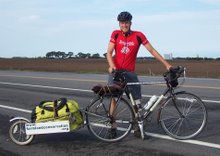


I think the award should be a copy of your published book...
Reply to this
I think you should write a book. I have enjoyed all your writing so far and when my daughter-in-law read your blog for the first time she kept on commenting.... He is such a good writer....
Reply to this