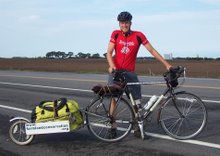
Tuesday, April 29, 2008

Today's Lunch

Good farming produces good food. Perhaps an entertaining way to follow the whole loop around will be to show you the wonderful challenge I'm faced with in preparing and eating all the organic food I work, barter, and beg for.

This past week I've had the daunting responsibility of putting down
-1 bunch carrots
-1 bunch beets with greens
-3 greenhouse grown tomatoes
-1 carton sunflower sprouts
-2 ounces cilantro
-2 pints strawberries
-1 bunch asparagus
-1 bunch brocolli
-1 bag leaf lettuce
-1 gallon whole raw milk

This weekend I spent a good 4-6 hours making

1) A carrot - cilantro soup - also using 2 pints homemade chicken stock and one potato. This is still in my fridge as we speak.

2) A roasted beet dip - Roast beets under foil in half an inch water and a little olive oil. Peel beet skins. Put in a food processor with 2 tablespoons orange juice, half cup sour cream, corriander and cumin. I'll post a photo later

3) Beet greens - cooked in a pot with bacon (sorry this was store bought) and onions.

4) One roast chicken with garlic lemon butter - I killed this chicken myself. See Day of the Chicken below for the whole story.

And last but not least.


One BST on sourdough. That's a Bacon, Sprouts and Tomato. It doesn't just look pretty.


Food courtesy of Woodland Gardens, Full Moon Farms, and assorted farmers of the Athens Locally Grown cooperative.

May all your meals be blessed,
J

Sunday, April 27, 2008

Field Day at Spring Valley Eco-Farms

Today we had about 80 or more people out at Dr. Jordan's farm for an educational field day. The rains blessed the midday from about 1 until 2:30, then the skies cleared and we were able to lead the crowd with relative ease.

Personally, I realized how important it is to have places like the farm to introduce people to new farming concepts, and the little 100 acre farm on Spring Valley Road is an amazing place for just such an activity.

The day and the group was split into three sections. Dr. Jordan gave an overview of the history of the farm and an introduction to soils and soil organic matter. Krista took folks up to her research plots to talk about no-till and alleycropping research. Jason used the bulk of the day to discuss the principle concepts of the vegetable operation and the new livestock enterprises.

It was a lot to take in a day. My role was mainly to transport the groups around the farm, and I enjoyed getting into conversations with our guests about yesterdays annual Old Timey Seed Swap, and the challenges we are up against in creating valid arguments for conventional farmers to make the switch to organic agriculture.

As much as I'd like to rehash all the great discussions of the day, I'll keep it simple and focus on the things that best caught my attention.

Jason's discussion of the spader was of great interest. This tillage tool is important in organic agriculture as a way to incorporate cover crop residues throughout the soil horizon without pulverizing the soil and damaging soil texture and organic matter. It penetrates to a depth of 14 inches. Cover crop incorporation should be carried out about 30 days before you plan on planting into the bed. I am breaking this rule pretty badly in my own garden this year. I tilled my weeds under two weeks ago and I planted lettuces within one week and now have planted okra and a few tomatoes this week. Oh well, I'm learning.


They don't make Spaders in the U.S. This one is from Italy. They come in quite a few sizes, including one you can use behind a walking tractor.

We showed the group the new Freedom Rangers chickens. These birds are a beautiful reddish color and come from European breedstock. They are considered hardier for organic and sustainable production, and also possess a richer flavor with more dark meat. Unfortunately the folks that run this business just closed it down so this might be the last batch of these guys. Back to the old Cornish Cross.

It's always great to get the opportunity to hear Dr. Jordan talk about soils and organic matter and how he realized we've really got our work cut out for us in the southeast in preserving organic matter. I love it when he brings up that the GA state legislature declared Red Clay as the official soil of Georgia, which he says is like declaring Smog as the official air of Los Angeles. I noticed today how he explains that because forests are perennial and slow growing, they don't have the same nutrient demands as your agricultural crops, so the slow release of nutrients from more lignous organic matter is not limiting. He then showed a cross section of soil from the vegetable plot and discussed how compost was needed on a regular basis.


Well. That's a quick and dirty summary. I've got an audio recording of Dr. J's talk that I'll try and link to my website soon.

Wednesday, February 27, 2008

A New Breed of Farm

A couple of weeks ago I came home for lunch and sliced a one inch thick center slice out of a locally grown, organic bright red tomato as big around as the length of my hand, laid it between two slightly toasted pieces of loaf rye bread, slathered it with mayonnaise, sprinkled it with fresh ground pepper and took a bite. It was about 40-45 degrees outside and overcast, but all of a sudden it felt like the sun was shining in my mouth. Eating a tomato this good at this time of year makes you feel like there’s a small crack in the firmament, and a small beam of heaven’s light focused just on you. I like to call that center slice the “steak” of the tomato, and there’s just nothing on earth as good.

Less than a mile away from where I live in Winterville, GA sits an unimposing small farm called Woodland Gardens. My yummy tomato was grown on this farm; only a stone’s throw from the Athens airport, and maybe six or seven miles from downtown Athens. Along the road in front of the farm is an itty bitty yellow sign that reads, “Organic Garden, please don’t spray.” Down a short dusty road stand ten tall domed greenhouses. A curious passerby might pause and say, “I wonder what they’re growing down there?” A good answer would be, “All kinds of stuff!”

My first visit to Woodland Gardens occurred one summer morning, about 4:30 a.m. It was pitch black of course, and I was hitching a ride to the Morningside Farmer’s Market in Atlanta; the only year round farmer’s market in the state that sells only organic products. Before heading off, I helped two lean, quick moving, hard working women load a refrigerated truck from top to bottom with boxes of tomatoes, carrots, cucumbers, beans, squash, zucchini, okra, lettuce, potatoes, onions, leeks, herbs, bunches of fresh cut flowers, and about a dozen items I couldn’t identify. Everything had been harvested the day before. This food was fresh. So fresh, it was practically wigglin’!

Everyone at the market was magnetized towards the Woodland Garden booth. The bounty of beautiful shiny fruits with chalkboard signs describing each item and how much it cost in blue, green and pink chalk. The bright colors and the smell of fresh cut flowers, ripening tomatoes and respiring greens entranced passerby. The fresh blessings of the earth had been brought to the big city.

Woodland Gardens isn’t an ordinary farm. It’s a new breed of farm; an example of what farms may look like if society truly decides to try and eat local. Most people can’t yet imagine what eating local actually means. To most of us it probably sounds trendy, unrealistic, or downright confusing. But current and future generations are facing some challenging questions that until the last few years were inconceivable. Where will our food come from? How will people make a living in our rural landscapes? What happens if everybody sells the farm?

Celia Barss is a new breed of skilled farmer. She’s young, she’s savvy, she speaks three languages and she’s the farm manager of Woodland Gardens. Born in Canada then raised in Papau New Guinea and Baltimore, she gained her training as a farmer at the University of California in Santa Cruz. She didn’t grow up on a farm, but she always loved to have her hands in the dirt, and after finding her passion for growing food she never looked back. She knew what she wanted to do and focused on it. These days a farmer doesn’t have to be born on a farm to be born to farm; and that may be a blessing to the rest of us since less than two percent of the nation’s population still grows our food. Celia is tanned, sinewy, and confident in her craft. There’s nary an organic farm or farmer in Georgia that can compare to the level of output, efficiency and quality of produce at Woodland Gardens.

When asked to paint a picture of Woodland Gardens, Celia explains the different structures that allow them to grow year round. A total of one acre of land sits under ten passively ventilated greenhouses called high tunnels, and two heated greenhouses. Four additional acres are devoted to field production. “Each area is the best place to have the crops at different times of the year,” Celia explains, and she’s developed a system of careful rotations to maximize crop performance and efficiency.

The major advantage of greenhouses is they allow a farmer to extend the growing season, thus providing year round income, maintaining full time employees, capturing a bit of a price premium, and allowing folks like me to eat local tomatoes in the month of February. But the greenhouses also preserve nutrients and organic matter in the soil. Since a greenhouse blocks rainfall, precious nitrogen from compost isn’t leached from the soil after a heavy rain. The plants are irrigated with drip tape and nitrogen is slowly released by the decomposition activity of micro-organisms in the soil. _

Every good farm starts with a farmer who loves doing what they do. Isn’t that true of excellence in any craft, and every profession? Celia explained that in addition to this love of the craft many farmers feel responsible for providing good food, “because they’re able to do it.” Fortunately for us, some people are just born with the talents that make for good farmers. They love being in the earth, they have a mind for detail, and possess bountiful storehouses of energy. Bit by bit these individuals are finding their way back to the farm as opportunities expand and society begins to appreciate this contribution. A new breed of farmer is slowly, ever so slowly being born. As this occurs individuals like Celia and places like Woodland Gardens stand out like an experienced older sister who just graduated from college. If you’re lucky maybe she’ll take you out, show you around, and instill in you an encouraging example of future possibilities.

Monday, October 15, 2007

Mule Days with Tim and Alice Mills

It’s 5pm on Saturday October 13th and I just got home from a lovely day with Tim and Alice Mills. I had called to schedule a time to interview them and they told me they were going to Mule Days in the town of Washington on Saturday morning and invited me to attend. It seemed like a good way to spend the day.

We met at their house at 9:30 that morning and had to wait a few minutes for their daughter Rebekah and son-in-law Brian and granddaughter Emma to get there. They had stopped at Burger King on the way over.

Tim was dressed in his characteristic coveralls and a plaid shirt. Before we stepped out Alice told Tim he needed to put his hearing aids in. Tim has a hard time hearing even with his hearing aids. We piled in Alice’s white Cadillac, which is the first authentic farmer Cadillac I’ve encountered, and Bryan and Rebekah followed behind in their Chevrolet Avalanche.

Washington is in Wilkes County so we drove through Winterville on our way over to 72 then took 72 through Crawford and Lexington and on for another 24 miles or so. On the drive over we talked a lot about the drought and how it had affected things. Tim and Alice have a 140 foot well that they water from, only the ground has shifted and lodge a solid rock into the shaft at about 40 feet. There’s still water at 40 feet but Tim talked about his idea to fire a rifle down the shaft to try and break up that rock. Their loyal and somewhat slow farm hand Paul is super excited about this idea.

Tim, Alice and Paul spent yesterday afternoon fishing up at the Jubilee Lakes and didn’t have any luck. I told them how all the refugees fish everything they can out of the lake and put the whole fish in the freezer, then take the fish with them when they leave for Atlanta. Tim mentioned he wanted to catch a turtle when he realized all the fish were pretty much gone. This got us talking about turtle stew which I’ve never had. I mentioned that it seemed they would be tough. The trick to making good turtle according to Tim is to feed them corn meal for about 2-3 weeks before killing them to clean them out of all the weird things they like to eat.

This got us talking about feeding corn, and how I’d noticed that the supermarkets were advertising “All grain-fed” beef like that was a good thing or something. This conversation was interesting as Tim’s familiarity with the Bible had led him to believe that “fattening” the calf was a biblical instruction from God, that there was nothing wrong with that. We talked about how ruminant stomachs respond to grain and the problems with strains of e-coli that can now be passed from a cow to a human due to the acidic stomach of a cow from eating grain.

The Mule Day was a popular event with cars lined up at the entrance. There was a show ring and a mule drawn plough demo on one side and food and vendors on the other. The event was staged at the Callaway House historic preservation center, a great little locale with a beautiful, stately plantation style home with pillars and big front porch and one of the tallest, thickest southern magnolias I’ve ever seen. It was probably four feet across. They had reconstructed an 1889 one room schoolhouse as well. There was a sorghum mill and they were cooking up the sorghum syrup. This was neat to watch. There was brick fireplace, built of two long walls on top of which they sat a long iron flume. The sorghum syrup was moved from one section of the flume to the other depending on how long it had been cooking. As it was cooking a bright green film of chloroplast coagulated on the surface and was skimmed off. At the farthest end the syrup began to simmer and gain its characteristic dark color.

One of the things I enjoy the most from these type events it the opportunity to learn a few new terms. Of course, sometimes I have to relearn some old terms. The purpose of the event was to celebrate the mule and a mule simply put is the offspring of a male donkey and a female horse. It’s an F1 hyrbrid so to speak, and usually unable to reproduce. Before we left the house, Tim had explained that one of the advantages of the mule is that they will eat of lot of things that a horse will turn their nose up at. They seem to be hardier in that regard and not as prone to problems such as foundering. There are all types of mules, and as they moved about the show ring the judge explained a little about the cotton mule which was narrower and able to do delicate field work.

There were wagon rides, and tons of food. We walked over for lunch. I had a rib plate and enjoyed gnawing on the bones under the shade of a pine, wiping my face with white bread, interspersed with bites of beans and potato salad. Tim generously offered a delicious brownie with giant chunks of chocolate embedded. I also picked up a couple of three dollar pieces of pottery for Christmas presents.

On the way home I learned a little more about Tim and Alice’s history. They talked about their rodeo days, how every weekend for about 2-3 years they would travel to a rodeo where Tim would often ride the bulls.

They had moved to Athens about 25 or 30 years ago coming from North Carolina where they both had family. Tim got a job on a feedlot owned by a man named Miller, and as part of the deal he provided them with a free place to live. It wasn’t much to look at they said, but they arrived in June and enjoyed fixing it up, adding carpets to cover nearly rotten floorboards and building kitchen shelves. Rebekah was five years old at the time.

When I first asked where they had lived when they arrived in Athens, Alice answered, “The Loveshack.” Anyone who has been in Athens for very long knows that this was where the band the B-52’s lived and wrote many of their early songs, and eventually memorialized the shack with one of their most popular songs. Alice said that the band actually came by one day wanting to visit their old stomping grounds and she and Rebekah got to spend the day with them.

Tim was working on a piece of equipment inside the silage silo and got silage sickness, which can affect you if you breathe the fumes coming up out of the fermenting silage. The gas produced is nitrogen dioxide and kills people every year during the process of filling and maintaining silos. Tim went to the doctor and was told he had two choices. He could take one week of bed rest or he could go the hospital. Well the Mills had no health insurance, so bed rest seemed the way to go. Tim’s boss, Mr. Miller was a hard man and told him he could have the afternoon off but he expected him to be back the next day. Tim said that was not going to work. They spoke the next day and Mr. Miller told him to be back that day. No matter how many times Tim tried to explain to him how serious this was, they had reached an impasse. Tim did carpentry jobs for several months and the family moved into the trailer of a man and his daughter about Rebekah’s age. It worked for a short time but Tim and Alice knew they needed something of their own. They sold the house they had built in North Carolina and bought the little yellow house on Harve Mathis road.


Tuesday, October 9, 2007

The Mill Farm Brunch

The Mills Farm Brunch was one of the shining moments of last month. It's been nearly one month ago now on Sept. 9th, but well worth going back to take a look at it. The event was a fundraiser for the Classic City Chefs & Cooks Association, the local chapter of the American Culinary Federation.

Tim and Alice Mills are two of my favorite people in all of Athens. They add a soul to our local foods scene that just makes me smile every time I think about them. I'll do a whole write up about them at some point but this entry is going to focus on the food we had at brunch.

You'll notice we just got a taste of everything, but it was perfect. Almost like a Tapas style brunch. Here's the menu....and the recipes.


Red Mule Polenta with Goat Cheese, Poached Egg, Truffled Hollandaise and Shaved Country Ham

Polenta:

1 cup Red Mule Polenta
2 cups chicken stock
1 tablespoon whole butter
1/4 cup heavy cream
4 ounces Sweet Grass Dairy goat cheese
Salt and pepper to taste

Poached Egg:

4 whole eggs
1/2 gallon water
1 teaspoon salt
1/8 teaspoon tarragon vinegar

Truffled Hollandaise:

4 egg yolks
Juice of 1/2 lemon
dash Chalula hot sauce
2 ounces water
8 ounces warm melted butter
Salt and white pepper to taste
1 teaspoon white truffle oil

For the polenta: In a sauce pan, bring stock to a simmer. Add polenta and stir for 2 minutes. Add butter and cream and cook for 5 minutes. Season to taste and reserve.

For the poached egg: In another sauce pan, bring water to a simmer. Add salt and vinegar. Crack each egg into a small cup and gently place in water. Poach until firm and reserve.

For the hollandaise: Over a double boiler, place a bowl with eggs, lemon juice, water, and hot sauce, whisking until eggs are 150 degrees and form ribbons. Do not scramble. Pull from heat. Whisk in butter and truffle oil.

To serve: On serving dishes, divide the polenta. Place one poached egg atop each dish of polenta. Top with Truffled Hollandaise Sauce and garnish with thinly shaved country ham.

Note: You can shock eggs in ice water and reserve in the refrigerator for use later that day.

- Recipe from Athens Country Club Executive Chef Christopher McCook, CEC


Saffron Infused Double Cream Vermont White Cheddar Red Mule Grits with Dry Rubbed Hickory Smoked Pork and Butter Bean Tomato Chow Chow

Grits:

2 teaspoons Saffron threads
6 cups chicken stock
6 cups heavy cream
2 teaspoons Kosher salt
2 teaspoons Coarse ground black pepper
8 ounces butter
2 cups Red Mule Grits
16 ounces cheddar, shredded

Smoked pork:

8 pounds Boston butt pork roast
1 cup JMCC dry rub
3 pounds hickory chips
10 pounds charcoal
12 ounces beer

Chow Chow:

1/2 cup yellow onions, finely diced
8 ounces cabbage, finely diced
8 ounces butter beans, cooked
1/2 ounce salt
1 cup rice wine vinegar
1/2 teaspoon dry mustard
1/4 teaspoon ginger
16 ounces green tomatoes, finely diced
4 ounces carrots, finely diced
4 ounces celery, finely diced
6 ounces sugar
1/4 teaspoon turmeric
1/8 teaspoon ground cloves

For the grits: Add saffron to chicken stock. Bring to boil, reduce heat and simmer for 10 minutes. Strain stock. Add cream, salt and pepper and butter bring to a slow boil. Add grits, whisking. Cook, stirring, for approximately 20 minutes. Add cheese and allow to melt. Makes 8 servings.

For the pork: Place chips in hot water and soak overnight. Rub pork with dry rub and wrap in plastic wrap. Refrigerate overnight. Light charcoal burn until gray and ashen (in a grill with a lid). Drain chips and spread over coals. Unwrap pork and place on a rack 12 to 18 inches above the chips. Cover and let smoke until wood chips are exhausted. Pull pork from grill, place in an ovenproof dish on a rack, add beer and cover. Place in a 300-degree oven for 4 hours. Remove from oven, trim fat and chop or shred meat. Add barbecue sauce to meat if you desire. Makes 20 4-ounce portions.

For the chow chow: Combine all ingredients in a non reactive pan bring to one boil, reduce heat to simmer and cook for 30 minutes. Cool and store refrigerated. Should be served with this recipe at room temperature. Makes 30 2-ounce portions.

- Recipe from Jennings Mill Country Club Executive Chef Lance Jeffers


Fried Griddlecakes with Country Sausage, Green Tomato Jam and Cane syrup

Griddlecakes:

3 cups Red Mule cornmeal
3/4 teaspoon of salt
6 teaspoons baking powder
Dash cinnamon powder
6 eggs
3 tablespoons of melted bacon fat
2 1/2 to 3 cups milk (at room temperature)

Green Tomato Jam:

3 pounds green tomatoes cut into 1/2 inch pieces
1 lemon
1 orange
3 cups sugar
1 teaspoon salt

Sausage patties

For the griddlecakes: Mix all of the dry ingredients together well. Add the eggs and continue mixing. Slowly add the milk until the batter reaches a pourable consistency. You may not need all of the milk. Add the melted bacon fat into the batter and continue stirring until well incorporated.

Spoon mixture into a well-seasoned pre-heated cast iron skillet and cook on one side until it begins to form an edge and is bubbling inside. Carefully turn and continue cooking until done.

For the green tomato jam: Place the tomatoes in a heavy bottom saucepot and cover with the salt and the sugar. Let them sit overnight. Take the zest off the orange and the lemon, using a zester; save this and reserve the juice. The next day stir the tomatoes and place over a low burner. Add the cinnamon. Add the juice and zest and cook slowly until tomatoes become fairly soft and the mixture thickens. Store in the refrigerator.

For the country sausage: Fry the sausage patties in a hot skillet, turning frequently until they reach an internal temperature of at least 165 degrees.

To serve: Place cooked griddlecake on plate, arrange sausage patty on top of cake, spoon green tomato jam on top, and lightly drizzle with cane syrup.

- Recipe from Athens Country Club Sous Chef Chris Borden


Girl Ponders Mule.

I took a lot of pictures of Tim's mule Luke who grinds all the corn into the grits, polenta and cornmeal pictured above. Luke's the hardest working member of the family. I like this picture of a girl staring deep into Luke's soul.

Sunday, October 7, 2007

Field of Greens

This morning I headed on over to Andy and Hilda Byrd's 2nd Annual Field of Greens fundraiser. They call it the "Organic Farm Aid" and have a good ole farm, food and music get-together with over 500 people with all proceeds going to benefit Georgia Organics.

Some of my closest farm friends were in attendance and its always good to meet new people at these type events. Its a tight knit community and one with great rewards. My camera only retained battery power for about 30 minutes so I was limited in my abilities to capture all the terrific goings-on.


This was Michael McMullen's daughter who had her own table where she was selling pokeberry seeds. She was incredibly articulate in describing for potential customers the medicinal benefits of pokeberry. Her beaming father stood nearby and commented after her eloquent delivery, "The benefits of home-schooling."


This is a goat. Aren't goats great?


This is an okra blossom. Pretty huh?


This is Tim Mills. One of my favorite people on earth. On the table there is his corn meal, polenta, and grits which he grinds with the help of mule named Luke.

Tuesday, August 28, 2007

A Day with the Dairymen of Georgia

Little did I know that Georgia's second biggest dairy region was only about 35 minutes south of Athens.

Morgan and Putnam Counties are north Georgia's last dairy counties. Today I was part of a meeting hosted by University of Georgia extension on helping dairy operators develop environmental management plans for their farms.

It was nice rainy morning, the kind that looks just like Portland, OR weather from the inside of a van, but once you took one step outside and were enveloped with the heat and humidity you realized we're still in the south and its still August. Myself and two UGA faculty took some remote, winding and quite pretty roads around the top end of Lake Oconee, passing through Greshamville, on our way to Buckhead. No, not the Buckhead in Atlanta. This is Buckhead of Morgan County. The two are just a little bit different.

We took a left at the bait shop and another left at the fillin' station and pulled into Bonner's Buffet Restaurant where the Georgia Dairy Association has its meetings every month.

We had our meeting. It was a tough sell to encourage these busy farmers of the utility of taking time from their busy schedules to develop an environmental management system (EMS) for their farm. It was a fairly new approach to addressing environmental issues, and its success rate hadn't yet been proven. At least not on farms. EMS's were originally conceived for industry as a way to be proactive, make continuous incremental improvements, stay ahead of regulation, and ultimately cut costs. Cutting costs had been successful for industry through implementation of an EMS. Thus far the EMS strategy on farms hadn't shown that many cost benefits.

There were some good questions from the audience. One observation made was that perhaps farms implementing EMS hadn't seen cost savings because farmers are already having to be as efficient as possible just to survive. The audience felt like there was some validity to this point.

The group performed an exercise where they went through a list of environmental management concerns on their farm and they ranked how important each one was. They performed this ranking for themselves as the owner/operator, but also how important these topics were to regulators, to neighbors and to environmental groups. The topics were on everything from nitrate pollution of groundwater, to erosion, to dust and odors, and wildlife habitat. They also decided to add water use to the list. It was interesting and maybe just a little surprising that they consistently voted themselves as having the highest concern on most topics. The group was really engaged at this point. Some of them recognized that they were very concerned about these issues and probably hadn't given adequate reflection on management opportunities on their farm.


After the talk it was time for lunch. Fried catfish, fried chicken, barbeque, french fries, hush puppies, slaw, watermelon and cherry cobbler. I went back for seconds and thirds and had about 4 glasses of iced tea. Over lunch I asked if they drank their own milk on the farm. To my surprise they said no, they bought milk in the store like everybody else. The fella sitting next to me said that when his father was still around they used to pick one cow out of the herd that they would hand milk for themselves. She was chosen for two reasons. She always showed the lowest bacteria count in her milk and she was nice and easy to milk. The only problem, it slowed up the line when she came into the parlor to be hand milked. He said they don't do that anymore. Both the fellas I was chatting with added that people come by the farm sometimes and ask to buy unpasteurized milk out of the tank. They'll always say, "We'll pay you." And these guys always respond, "I don't care. I can't sell you that milk." Unpastuerized is illegal to sell in Georgia and there would be stiff penalties.

The extension agent who was sitting with us added that recently some folks got sick who were drinking raw milk that was being sold as pet food (one method farmers have used to sell raw milk). I wanted to know more about their personal tastes and distinctions for milk from the farm vs. the grocery store, but I got the impression they didn't really think that way. They were interested in my visit to Russel Johnson's farm and his plans to build a bottling facility and selling his milk direct to grocery stores.


During my final conversations on the front porch this little stray kitten kept climbing up my leg clear up to my belt. That cat had more personality than most any cat I've seen. Would've made a good farm cat. If only I had a farm.

Thursday, June 28, 2007

Week of the Chicken!

Bright and early Monday morning of this week I giddily awoke, made a cup of coffee, put on a dark black t-shirt (the one with NY's jazz club the Village Vanguard on the front), jumped in my car and drove toward the glowing orange sun. I also had on pants!

It was about 6:45 in the A.M. and today was chicken slaughtering day. I feel fairly confident that I was one of only 4 other people in the Greater Athens area that were going to be slaughtering, scalding, plucking, eviscerating, chilling and then packing 100 chickens under God's blue sky.

For the last 8 weeks two small square pens, approximately 10x10 constructed of wood, chicken wire and a tarp had been holding 50 chickens each as they were moved once per day across a pasture beneath a palonia orchard. These chickens and these pens, undneath these trees, on this grass, on this farm, in this day in age offers more hope, knowledge, and wisdom than may be evident upon first glance.

Chickens haven't been treated very well by humans over the last 30-40 years or so. What I mean by that is imagine spending your entire life at a Rolling Stones concert, standing room only, shoulder to shoulder, in a windowless stadium, all the bathrooms are closed, and the band never shows up. That's kind of what life is like for a factory chicken.

Having spent some time in these chicken factories, I've never met a farmer who loves what they are doing. As many people have pointed out, it doesn't really resemble farming. When you walk in, you are smacked in the face by the heavy smell of ammonia. There are no windows so the 50x500 foot house is dimly lit (just about all day to keep the chickens eating 24x7). There are 30,000 chickens, and your job is to pick up the ones that have died, and make sure the automatic waterers, feeders, and temperature monitors are working. Getting a kid to go into one of those things day after day can't be easy.

With pastured poultry, a farmer is outside. The chickens have all the fresh air and sunlight they could want. They are moved each day onto fresh grass which they happily munch on, and pick through the soil looking for bugs. Each day they lay down a fresh layer of manure to help fertilize the pasture, which helps the grass grow for the cattle that will be following behind. They don't have to spend a single day in yesterday's excrement. It's fresh, clean and sanitary.

Now in the end the chicken does still get killed and eaten. Such is the price paid by a domestic fowl in an omnivorous world. But the important question is, did the animal live a good, tranquil, healthy life? Was the animal under intense stress? Was it deprived of its "unalienable rights" of fresh air, grass, bugs, ability and room to move around, freedom from one's own feces, and sunshine. No. By all accounts these birds have been happy!

Our crew of 3 were excited. This was the inaugural day of chicken slaughter on this particular farm. The very first batch. There was never going to be another first time, and I wanted to be a part of the ceremonial celebration of the good lives these chickens had led, and the unique nourishment they would afford to a whole mass of people.

Set up began promptly at 7AM. There were cutting tables to wash down, kill cones to set up, a turkey fryer would serve as our scalding pot. A brand new feather master would pluck the feathers. Then there was a tray for catching the blood beneath the cones, and a garbage can for the eviscera, and another tub for offal (the feathers). We had sharp knives, and matches, and a pulley system for dipping the birds in the scalder. It was all set up in stations. After about an hour of getting things together, we were anxious to try it out.

The birds were taken from their pen out in the pasture and put into a pen on the back of a pickup. Each bird was then stuck into an upside down traffic cone which was affixed to 2x4 across two trees. The top of the cones had been cut off so that the birds head was sticking out of the bottom. In such a position the birds can't move their wings and get very still and quiet. The most difficult part of the operation is the kill itself. It's done by simple grabbing the birds head and cutting their main artery on the side of its neck. This may be the hardest part of the procedure because the bird's don't die instantly. Cutting their artery allows the heart to continue to beat removing the blood from the body which can leave a bad taste to the meat.

Once bled, each bird (now dead) is removed from the cone, and it's fit put into a pulley situated over a vat of hot water at 145 degrees. The bird is then dipped / submerged into the hot water repeatedly for 1 minute. This loosens the birds feathers for plucking. Rather than hand plucking, they are placed into an apparatus that resembles a large salad spinner with little rubber fingers with grooves in each finger that grasp and remove the feathers as the bird is spun around and around. As they spin around a mist of water continues to clean the bird.

Once the feathers have been removed, the birds now are starting to look like food. They are placed on the cutting table and the head is simply pulled off. The feet are removed at the joint, leaving the end to your drumstick handle. The oil gland above their tail is cut off, then a cut is made at the neck to seperate the esophogus and the crop. To eviscerate a small sideways cut is made above the anus (or the "vent" is a nicer way to put it). Enlarge the opening and then scoop out the organs in a scooping motion. The trick is not to break the intestines or especially the gall bladder (a bright blueish green organ that secretes bile to the liver). The lungs kind of cling to the rib cage and have to scraped out, then the anus is cut out, and a hose is used to wash to wash the body cavity clean. That's it. Throw it in a tub of ice water to cool the body down and it's time to go home and eat chicken.

I spent about 5 hours on the farm that morning with my other excited co-horts. I stopped at one point to exclaim, "This is fun!" And it was. My real job was expecting me so before we finished all 100 birds (we were over half way there) I had to head off.

It was about noon and as I drove back into Athens I felt like an adventure. There was a fresh whole chicken in a ziploc bag on the seat next to me. I went in my apartment and threw the bird in the fridge while I took a quick shower to rinse the smell of chicken fat from my skin. I put on clean clothes, grabbed my laptop, jumped on my bike and headed towards campus. As I looked around at people walking down the sidewalk I thought how lucky I'd been to have spent the morning on a farm just out of town contributing to the cycle of life. It was Monday and it had officially become the Week of Chicken.

The first day I had Thai Peanut Sauce stir fry chicken breasts and tenderloin with bok choy, brocolli, onions and garlic. The remainder of that meal I had for lunch today. Day two was baked Jamaican jerk chicken legs cut into slices and put on a sandwich of locally baked sourdough bread, and some organic lettuce from California probably, a little Grey Poupon and Mayonaisse. Third night I used what was left to make my mother's famous chicken casserole. You're going to pass out when you hear the ingredients. One can cream of chicken soup, 8 oz sour cream, 3 breasts of chicken, butter the dish, crush one whole pack of Ritz crackers on top, drizzle butter on the crackers. I can't believe I didn't die of heart disease eating that way growing up. But it's delicious and this week is the first time I've ever made it myself. The family recipe is alive and well.

The only way I can get closer to my food now is to get my own farm. The temptation is growing.

Till next time,
Justin

Sunday, April 8, 2007

The Blessing of Food

One of my best friends made a dramatic decision a few years ago just shortly after a very brief stint working for the Howard Dean presidential campaign. For reasons unknown and mysterious to me, he decided to become a farmer.

My friend had always been a bit unconventional, which is probably apparent considering his devotion for Howard Dean, but he’d obtained a bachelor’s degree from a very respected liberal arts college and shortly thereafter landed a job as Executive Director of a small non-profit tasked to defend a very grand resource; the Coosa River Watershed. The job followed a canoe trip he had completed of the entire Coosa / Alabama River system, a voyage lasting three months beginning in the mountains of Georgia and ending in the Gulf of Mexico at Mobile Bay, Alabama. Our friendship was born of our mutual passion for rivers, and most of our get-togethers involved paddling, fishing, hiking and camping adventures all across north Georgia.

One of the great pleasures of making friends with eclectic and determined individuals is the opportunity to watch them as they travel down winding and enriching new paths in life. He called me after returning from Iowa and a thoroughly disappointing experience on the campaign trail and informed me that he was going to start farming. After one year of intense training, living and working with a farm family in the hill country north of Asheville, North Carolina, he returned to Georgia and worked out a deal to set to work on a piece of river bottom land near Ranger. What followed was nothing short of miraculous.

For the first four months he lived in a tent underneath a tarp, cluttered about with all his earthly belongings. He had a phone line, and he’d convinced the power company to install a meter so he’d have power, even though there was no house associated with it. Other than that there was nothing but bare ground, a vision, and a whole heap of work. Many hands make light work, and my friend had a knack with people. He’d maintained close ties with his college community and as a result was rarely alone on his little patch of soil. If you dropped by for a visit, he’d have a job waiting for you.

Within just one year the farm was cultivating fruits and vegetables on about three to four acres. He’d invested in a tractor and a beat up pickup, erected a 100 foot hoop house, a seedling greenhouse, and with a lot of help from friends had constructed a pole barn house roughly 30 by 40 foot and 16 feet high with a tin roof. The fact that he had built a house in a matter of a few months impressed me the most. The design was unconventional, but practical and inexpensive. He’d put in subflooring with insulation underneath, and heated the home using a wood burning stove set dead center with the pipe going straight through the tin roof.

His most ingenious idea was constructing the walls of the barn out of inexpensive vinyl billboard sheets. Billboard advertisements are printed on heavyweight, weatherproof, vinyl sheets. He was able to purchase two of these for a couple hundred dollars and fasten them as his walls. When sitting inside the house one of the walls featured a floor to ceiling picture of a Shoney’s Big Boy hamburger and another wall featured a Chrysler 300 sedan. There was no indoor plumbing but there was a wash basin with a bucket underneath. Hot water had to be heated atop the wood burning stove. There were two bedrooms which were actually 8x10 foot lofts sitting above my friend’s library/office on one side and living room on the other. He had an internet connection, and a television, VCR, and stereo. It was one of the coziest, cutest little homes I’ve ever been in, and it was a happy place.

My visits to the farm had a deeper impact on me than I realized at the time. One of the first things I noticed was that the foods my friend was eating were a lot different from the foods I typically ate. The breads and cereals were always whole grain, and often fresh. I remember thinking that the flavors were a lot more complex, I wasn’t sure that I liked them at first, but I could certainly tell that there was a density to these foods that I didn’t feel when eating white bread. Most of the folks on the farm were crazy about salads, and I was exposed to a world of greens I never knew existed. A lot of thought went into the food eaten on the farm. One of my more exciting visits occurred a few weeks after I had hit a small deer on the highway, taken it home and cleaned and dressed it, then carried some of the hams to the farm to be ground up into hamburger meat. It was fun to swap food and swap stories. A woman who lived nearby would bring her farm fresh eggs and trade for fresh strawberries out of the field and other produce of the week.

One of my first visits after the pole barn had been completed, there were about four of us there including my friend’s girlfriend, and we had all pitched in to prepare this great meal of fresh foods now spread out on the table. We were about to sit down and eat when my friend paused and said, “Let’s bless this food.” It was the first time I’d ever heard him suggest such a thing. The brief prayer that followed will always be a moment that I will remember. In a short period of time farming had affected a deep change in my friend’s life. His generous spirit, his strength, his humility, his calm all came into focus in his life as a farmer. I felt so happy for him, so proud of him, and so inspired by his example. Little did I know that moments like this would ultimately penetrate and influence the course of my own life just as deeply.

As his words of thanks put a blessing on the meal, the moment allowed each of us to reflect on the importance of our simply being together and sharing in good work and good food and good company. I’ve thought a lot about why that blessing, that meal, in that house, with those friends was so poignant to me. Since then I’ve sought the occasion to bless a meal. It’s a practice I fail to do everyday, but in the seeking I’ve opened a whole new world of meaning and relationship with the people who daily cooperate with the earth so that the rest of us can have something to eat.

Wednesday, March 21, 2007

Here we go Again!

Hello folks.

I'm back. So after a gentle respite from writing I have decided it is time once again to force the issue by committing to a blog format. I have learned that you write more when people expect you to write.

Beginning in April and ending in November I wrote extensively about a cross country cycling adveneture to discover America's Farms. You can find that Blog at www.farmlandconservation.org. That experience has led me onwards to a whole new world of exciting challenges and experiences with farm policy, local Georgia farms, opportunities in sustainable agriculture.

I have learned from my prior writing experience that you simply cannot retain nor make sense of your experiences unless you are capturing them along the way, all the little quotes that people say, your impressions at the time. They make a huge impact on the value of those stories. Well I don't won't to allow any more of them to be lost than already have so I'm going to begin sharing them again here.

This is just the warm-up. I'm a little out of practice already but I'll be back up to speed soon.

Thanks for coming back.

Friday, November 17, 2006

Mission Accomplished - The Big Wrap Up

The Source of Sustenance

My coast to coast bicycle journey in search of how to preserve America's family farms has successfully been completed. After having a few pictures taken of dipping my front tire in the Pacific Ocean I arrived in Astoria, OR on Friday, October 27th with a big smile on my face. Riding a bicycle from one ocean to another, across ten states, covering 5,000 miles, visiting nearly 80 farms over the course of four and a half months is not an easy experience to summarize in a few words. The first word that comes to mind is “fortunate.” I was fortunate that God put into my mind the desire and the conviction to carry out such a thing, and that I was physically and mentally capable and determined enough to complete the effort. My final day began with a walk along a secluded beach, listening to the sounds of the ocean and filled with a rising sense of thankfulness. I never went hungry, I never suffered injuries, was never harassed (save the occasional honking of a horn), and was never turned away when in need of assistance or a place to stay. Perhaps calling it “good fortune” minimizes the significance of my well being during these last months to a sort of cosmic fluke; an uncanny roll of the dice. Perhaps a more accurate description of how I'm feeling at the end is superbly blessed.


The final dipping of the tire in the Pacific Ocean at Cannon Beach. (Goonies rock in the distance)

The accomplishment itself, of overcoming all the psychological and physical obstacles and completing a hard won goal, has strengthened my faith and confidence in my own abilities. This is a new perspective for me, and one to be cherished. About two-thirds through the trip I began hesitantly mentioning to people that I wanted to write a book, but I wasn't quite sure I could do it. “If you can ride your bike across the country,” they responded, “you can do anything you set your mind to.” That statement coupled with a now tangible achievement has lifted the limits I formerly imposed on myself. When plagued with doubt I can always remind myself, “If you could ride your bike across the country, why not this?”


I have never learned more in a shorter period of time than I have these last few months. First and foremost, I will never be able to look at food the same way again. All food has an origin, and I will enjoy food best when I have an understanding and a respect for those origins. There are lots of ways to raise cattle, to grow an apple, to plant and harvest wheat, to operate a dairy. All food is not the same; there is a story behind our sustenance. A farmer's philosophy, practice, and knowledge greatly determine the nutrition of the food, the well-being of the animals, the integrity of the landscape, the character of the family, and the culture of the community. When we buy food at the grocery store we rarely know any of these things. In the midst of our so called “information age”, we have never known less about the origins and the impacts of the food we consume everyday. If my journey was in part a search for more enlightened living then my next steps are too seek out locally produced foods, indeed, even encourage them. My food dollars spent at the grocery store just don't support the things I care about anymore.


To say that I've developed my interest in agriculture the long way around would be an understatement. I grew up in a suburb of Birmingham, Alabama. I'm certainly not ashamed of my roots, but I also recognize that city life deprives the human spirit of a deep understanding of the source of all things. For the urbanite, our sustenance in the form of food, water, and even fresh air is generated in some mysterious manner on lands unknown. We take for granted the processes of nature, or the labor of our fellow man that keeps us alive, and as a result we make poor decisions. These decisions have had consequences to the health of our bodies, and to the health of rural communities.


I am grateful that after so many years, my ignorance about food and how it is produced is slightly less complete. The ground feels a little more solid beneath my feet as a result. But it has been the means by which I have acquired this knowledge that I now recognize as so unique. How fortunate I've been to study one of the most basic aspects of our daily nourishment; not in a classroom, not from a book, but directly from the farm families whose very lives provide something for the rest of us to eat. I witnessed hundreds of little snapshots of mankind's relationship to the land. As I learned about wheat, or cattle, or peaches, it was always within the human context of an individual, a family, a farmhouse located in a particular valley, situated in a particular state. As I roll over the trip in my mind, each farmer had a unique story to tell, and because I was looking, some wisdom to share. Before the printing press, before radio, before t.v., and before the Internet, our knowledge of the world was exchanged orally, directly from individual to individual. This form of communication differs from the others in that it requires no technology, it is direct, it is personal, it is interactive, and it is relational. In the process of my search for knowledge and understanding, I ended up gaining friends.


It hardly seems possible that in the course of a few hours I would make such strong connections with total strangers. I think it had something to do with the bicycle. A bicycle traveler is easier to trust. If we were up to no good, we sure hadn't devised a very good get away plan. And because of our vulnerability, the human heart is called to assist. By riding thousands of miles on a bicycle to see them, and asking them sensible, important questions, I often sensed my hosts rediscovering the significance in the way they lived their lives, and the value of their contribution.


“So what is it going to take to keep farmers farming?” This was but one of many ways I asked the question at the heart of this trip. An easy answer never materialized. What did materialize, in my heart and mind, is a deep appreciation for the land and the beautiful way in which God and nature have allowed us to provide for our own nourishment. The diverse, and often inconsistent answers to my question may come from farmers themselves, from more enlightened consumers, from farmers markets, from alternative food sources, from public policy, or from rural communities that can take charge of their identities and their future. But the starting point for such grand undertakings are simple enough. Each individual will have to pause a moment, examine their life, and make a conscious decision to rekindle a relationship with the source of their own sustenance.


Thank you to everyone who has experienced this journey along with me. I received so much support and encouragement throughout the adventure, and as a result I never felt alone. It also inspired me to push on during the rough patches. Without the prayers, the kind words, and yes, the donations and t-shirt purchases, I don't believe that this trip would have been the success that it has become. I owe an impossible debt to a great many generous souls out there. My only hope for repayment is to continue down the strange path of discovery I've now found. I promise to share some stories along the way.


I think this has to be my favorite photo from the trip. It's me and Susana Lein posing American Gothic style in celebration of our efforts to rescue her delicious Bloody Butcher cornmeal corn. Our tools were simple....stakes, twine, and a small sledge. Doesn't everyone use these tools when growing corn? One of us is taking our re-enactment a bit more serious than the other.

Friday, November 3, 2006

Final T-shirt entries

I sure enjoyed all the t-shirt entries I received. I'll try and compile them all on one page and let folks decide which is their favorite. Anyone ever come up with any bright ideas for an award?


Now this was what I was hoping for. Farmer models looking sexy in their lettuce. Awesome. Big thanks to my good friend Noelia Springston for sending this photo of her husband laying in a bed.


My handsome and intelliget cousin Harris Blackstone supporting the cause.


Thanks again to everyone who purchased a shirt. I wouldn't have been able to do the trip without your contribution. I'll try and compile a list of my benefactors.

MORE >>

Posted by Justin Ellis at 11/3/2006 1:42 AM | View Comments (2) | Add Comment | Trackbacks (0)

  • 11/7/2006 9:06 PM Rebekah wrote:
    I think the award should be a copy of your published book...
    Reply to this
  • 11/7/2006 11:05 PM vicki pense wrote:
    I think you should write a book. I have enjoyed all your writing so far and when my daughter-in-law read your blog for the first time she kept on commenting.... He is such a good writer....
    Reply to this


Message from a stranger

I received this e-mail message after my final day of riding....

Hello,Props to your wonderful, inspiring efforts. I admire yourdetermination and feel honored to live in the city that you celebrateyour journey's end. I was driving home and noticed how gracefully youglided up the quite steep hill outside our house on Franklin Ave.Most cyclists are huffing and laboring up it, but I sensed there musthave been some experience in your pedal strokes. Looked up the siteon the bike trailer sign and found such an inspiring endevor that gaveme a few shivers as I beheld the beautiful pictures of your journey.I am totally behind you and your mission. I often wonder what willhappen to the farms that so many people identify with as their roots.They may have some ancestor that was involved in some form of lifesustaining ariculture or might remember the neighbor's field of melonswhich has now gone to land developers. Where will we be when we areno longer identifying ourselves or at least acknowledging that withoutthis connection with the land we live on, it may give way beneath us?I had a short experience with the joys of farming in my years inhighschool at a self-supporting school. Some of the most memorableyears of my life were spent there dividing studies and work during theday. The work, the most enjoyable part of the day, was on the smallorganic farm which supplemented the schools income and also thecafeteria menu. There was also a small flock of wool sheep that Ipersonally tended to each day as a part of my duties. The wonderful feelings of scooping up freshly plowed earth in your hands, pulling upthe first tender carrots, the ache of the whole body after anafternoon of hay bucking. None of this can be adequately described inwords.

The joy all of these memories give me hope that one day my husband(whom I cultivated a friendship with while working on this same farm)and I will be able to try our hands at sharing life with the land.Thank you for reminding me of how precious our country's agricultureis and for your valiant efforts to remind the rest of the country ofthe same.Congratulations and hope your trip home is peaceful and safe.

Sincerely,
Carrie

My reply: Thanks Carrie!

Thursday, November 2, 2006

Scenes from Oregon part 2


Even the bus stops in Oregon are cool. Not to mention that this bus stop is out in the middle of the country. That's a field next to that bus stop. Oregon is cool.


Travellling through the Willamette Valley during fall harvest was one of my numerous lucky breaks of the trip.


Jim Calkin of Heavenly Harvest Farms is a mastermind of agri-entertainment. This was my first encounter with a corn cannon which fires whole cobs one hundred feet using compressed air. Jim's daughter comes home everyday from school and practices her pneumatic riflery. A shot inside the barrel wins $50.


A rain storm drove me inside this barn for lunch. This old Farm-All tractor had personality.


I desperately wanted the whole trip to be able to visit a full scale dairy operation. My wish came true just three days before the end of the trip in a little town called Hebo, OR. I had stopped and asked for a place to sleep at the Hebo Christian Center and they graciously arranged for me to visit fellow member Tony Hurliman the next morning. Tony was fantastic. Completely enthusiastic about the dairy life and just a good natured human being. He loved his cows as much as a man was ever intended to love a cow. And they loved him. As we stood in his pasture talking his entire herd came to gather around him, and nuzzled him, begging to be petted.


This was Tony's father and a heckuva character. The day was his birthday and he was 85.

Saturday, October 28, 2006

Press on the Trip


Good Press was a difficult thing to drum up on this trip. At the early stages I just didn't feel like I had a firm enough grasp of what I was doing to try and talk to reporters. And of course there was the time factor. In addition to riding 50-60 miles a day I was trying to visit farmers, write a weekly newspaper article, take notes, take photos, find a place to sleep each night, and make sure my family wasn't freaking out. So I didn't have a lot of time to look up local newspapers and tell them my story.

Then a good friend Michelle Blackwood set up an interview for me with Kingman Leader-Courier while I visited her families farm in Kingman, KS. Michelle had seen my entry entitled Problems Abound, and generously offered to help with a few of them.

The interview was hilarious. When I took a step inside of the office headquarters it was like walking into a paper from 50 years ago. The place smelled like old newspaper, primarly because all the old copies were kept in a disorganized clutter in the back room. Talk about a fire hazard. The editor/publisher did the interview and asked all about what kind of food I ate at night, where I slept, how long I'd been on the road.....and then....that was it.....the interview was over. We had spent about 5 minutes talking about his son who had lived in Georgia and then about 5 minutes on the interview. Nothing about farms. When I told the Kinsler's (Michelle's family) about the interview they laughed and said, "it'll be a miracle if any of the informaiton you gave is correct". A few weeks later my sister called and said she had received a copy of the paper in the mail. They had taken a couple of pictures of me. One of them was actually on the front page, and then the second photo was also included inside the paper with the second half of the article. The pictures were virtually identical. Once I get back I'll type it up and publish it because based on my sister's reading it should be quite entertaining.

Shortly thereafter I wrote a press release and started sending it to a few larger papers a few days to weeks before my arrival. No one responded. I even called a few. Often I never even talked to anyone who had seen the press release. Given my limited time, I pretty much gave up on the idea and focused on more fruitful pursuits. Then every once in a while I'd jet a few out.

Finally I got an e-mail from the Nugget Newspaper in Sisters, OR from Jim Cornelius.The interview was at 10:30 in the morning, but it was a cloudy, groggy day, and Jim invited me into his office which resembled a bear's den. It was completely dark and he sat in the shadows and began to interrogate me. It just wasn't the kind of environment that elicited inspirational vocabulary. After each question he would kind of sternly peer into me as if to see if anything interesting could possibly fall out of such a dull story. In all fairness, Jim was very helpful in suggesting I visit the Small Farmer's Journal before leaving town.

So here is the result of what I thought was a miserable interview.

Before you read it I should add that I had a couple other encounters. One was a story in the Wyoming Livestock Roundup, a real live ranchers paper. I can't imagine the conversations it must have stimulated. I need to ask for a copy of that story as well. Finally, just yesterday a young woman named Shasta with the Tillamook Headlight Herald stopped me while shopping for fruit at a roadside Farm Shop called Bear Creek Artichokes. She had just graduated from college in Eugene and this was her second week on the job. She saw that I was bike touring and asked if she could interview me. We sat on the hood of her car and for about twenty minutes all the ingredients of my trip began to come into focus. I don't know what she'll write but I told her everything from Thomas Jefferson's agrarian vision for the nation to statistics on the percentage of American's incomes spent on food relative to our past and to every other nation in the world. I loved it.

Without further ado....here's that Nugget article.


Cyclist takes pulse of U.S. farming

By Jim Cornelius
News Editor

Justin Ellis is nearing the end of his cross-country bicycle trek. photo by Jim Cornelius
Justin Ellis' business card lists his occupation as "Seeker."

It's a pretty good job title for a young man who spent his summer trekking across the United States on a bicycle, visiting farms to discover the state of American agriculture.

He's visited 60 farms in his trek and has discovered - to no one's surprise - that farming as a way of life is under stress in America.

"People... are skeptical of future prospects," he said.

Farmers feel a reduction in the pride and respect accorded to their way of life, and many are not sure they want to see their children carry on what has been for many a livelihood and culture spanning generations.

Ellis saw evidence of this before he even started his trek, in his home town of Clarksville, Georgia.

The community is rapidly changing, with an influx of newcomers with no connection to the poultry farming that has been the town's economic mainstay. The sense of common values is eroding.

"There was a lot of division in the community that wasn't there before," Ellis said. "You just didn't have the same community dynamics that you did. The community ceased to have pride in (its farming heritage)."

That kind of change was a common phenomenon across the nation. Ellis chose the bicycle largely in order to get a closer view.

"I thought I'd understand it better if I visited these farms by bicycle instead of the rapid pace of an automobile," he said.

His seeking has a purpose. Ellis is in a master's degree program at the University of Georgia, heading for a career in shaping agricultural policy. He hopes to craft policy that will support small farming.

"I needed to understand the playing field better," he said.

The picture is not all bleak. Ellis noted that many farmers and ranchers are finding local niche markets with high quality, specialized products. The model of Oregon Country Beef, which seeks local markets and partners with restaurants such as Sisters' Depot Deli, may hold out real possibilities for farmers.

"The farther apart the producer is from the consumer, the less viable it is for the farmer," Ellis said.

The cultivation of local markets may be an antidote to the erosion of farmers' ability to make a living.

"People are seeing hope in that," Ellis said.


Comments
10/31/2006 7:54 AM Rebekah wrote:
The article and picture turned out to be impressive.